Vacation Rental and Booking Website Templates (2026)
Compare 7 vacation rental and booking website templates for 2026: Next.js with an availability calendar, Stripe and host dashboards, plus WordPress and Laravel.
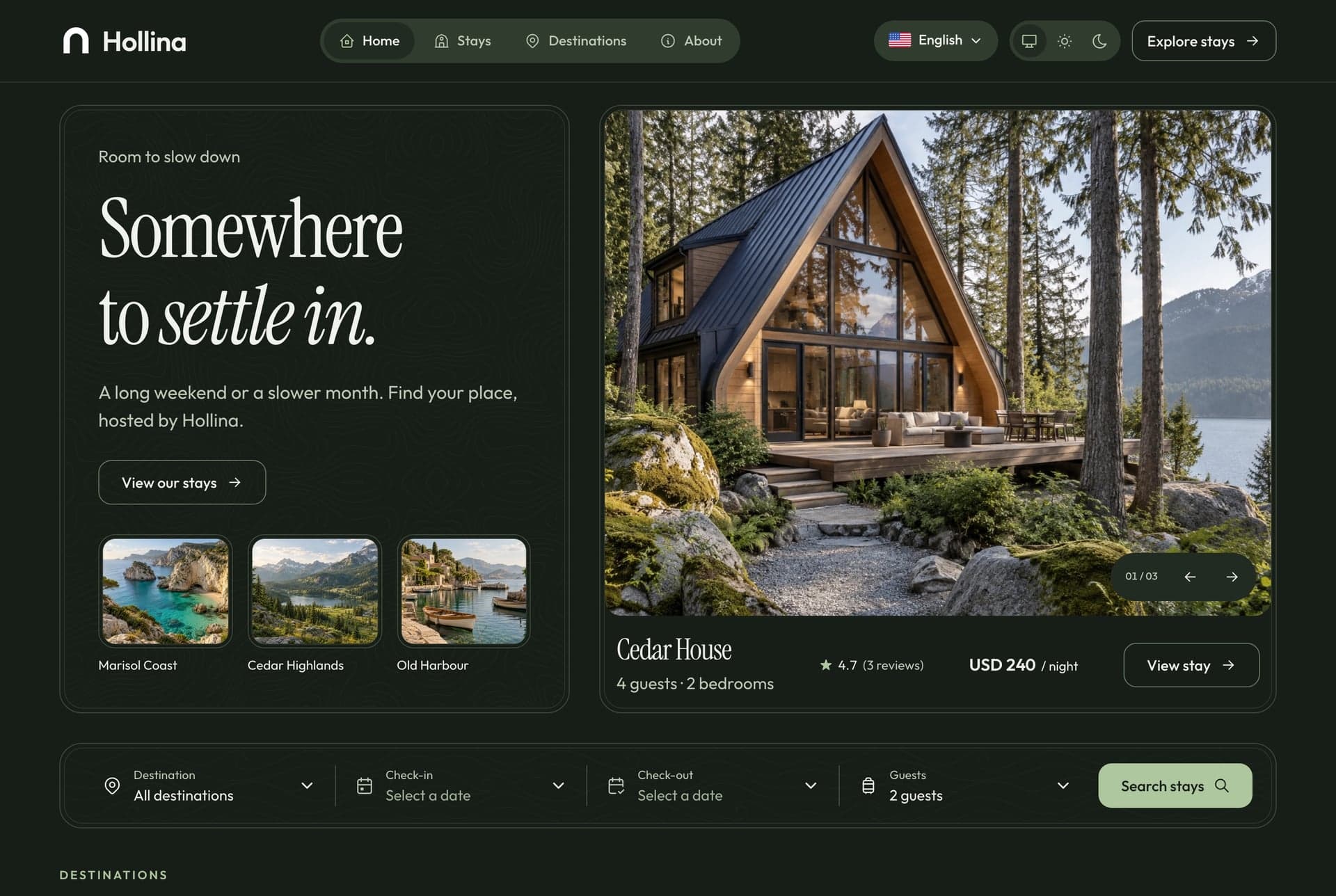
This is a buyer's list of vacation rental and booking website templates for 2026, written for hosts and property managers who want their own booking site, the developers they hire, and agencies that build booking sites for clients. Every pick below shows stays with dates and guests, and most go further: an availability calendar, a checkout, a host dashboard or a full booking engine. They come from different places: a premium template store, ThemeForest and CodeCanyon, a WordPress theme with a booking plugin, and a free open-source project on GitHub.
The question that decides everything is what "booking" means in each template. In some, the date picker and the checkout are designed pages with no backend behind them, so a booking goes nowhere until you connect one. In others, the nights are checked against a calendar, the guest pays, and the booking appears in a dashboard for the host. The Booking column in the table says which is which. We opened the product page of every pick while writing this list, and prices were checked on each product page in November 2026.
If you want a step-by-step view of how a direct-booking site fits together (stays, availability, checkout and the host's side), our guide on how to build a vacation rental booking website with Next.js covers that part. This post compares the templates you can start from.
| Template | Best for | Booking | Backend | Arabic/RTL | Price |
|---|---|---|---|---|---|
| Aniq UI Hollina | One host company taking direct bookings | Availability calendar, Stripe, PayPal or pay on arrival, booking lookup, host dashboard | Own NestJS API (Backend API or Full Stack package) | English and Arabic, full RTL | From $39, Full Stack $149 |
| Chisfis | An Airbnb-style site with stays, cars and experiences | Search, listing and checkout pages on local state | None ("No backend" on the listing) | RTL layout switch, Arabic not listed | $39 on ThemeForest |
| Aquarelle | A small hotel or guesthouse | Room availability, booking form, Stripe and pay on arrival | Directus CMS with SQLite | Not listed | $24 on ThemeForest |
| Villagio | A host with a few rentals on WordPress | Booking plugin with calendars, seasonal rates, iCal sync and payments | WordPress with MotoPress Hotel Booking | Not listed | $89 on ThemeForest |
| Booking Core | A marketplace of many hosts | Hotels, spaces, tours, cars and more, with vendor commissions | Laravel 12 with MySQL | Multi-language and RTL listed | $69 on CodeCanyon |
| TripFinder | A rental listing front end on a budget | Search and listing pages, booking flow not described | None described | Not listed | $17 on ThemeForest |
| VacationHub | Studying an Airbnb-style app | Listings and reservations, no payment step in the README | Next.js with Prisma and MongoDB | Not listed | Free (MIT) |
Best Vacation Rental and Booking Website Templates in 2026
1. Aniq UI Hollina
Best for: vacation rental hosts, guesthouses and property managers who want guests to book and pay on their own website, and the team to run the calendar and the bookings from a dashboard, with English and Arabic built in.
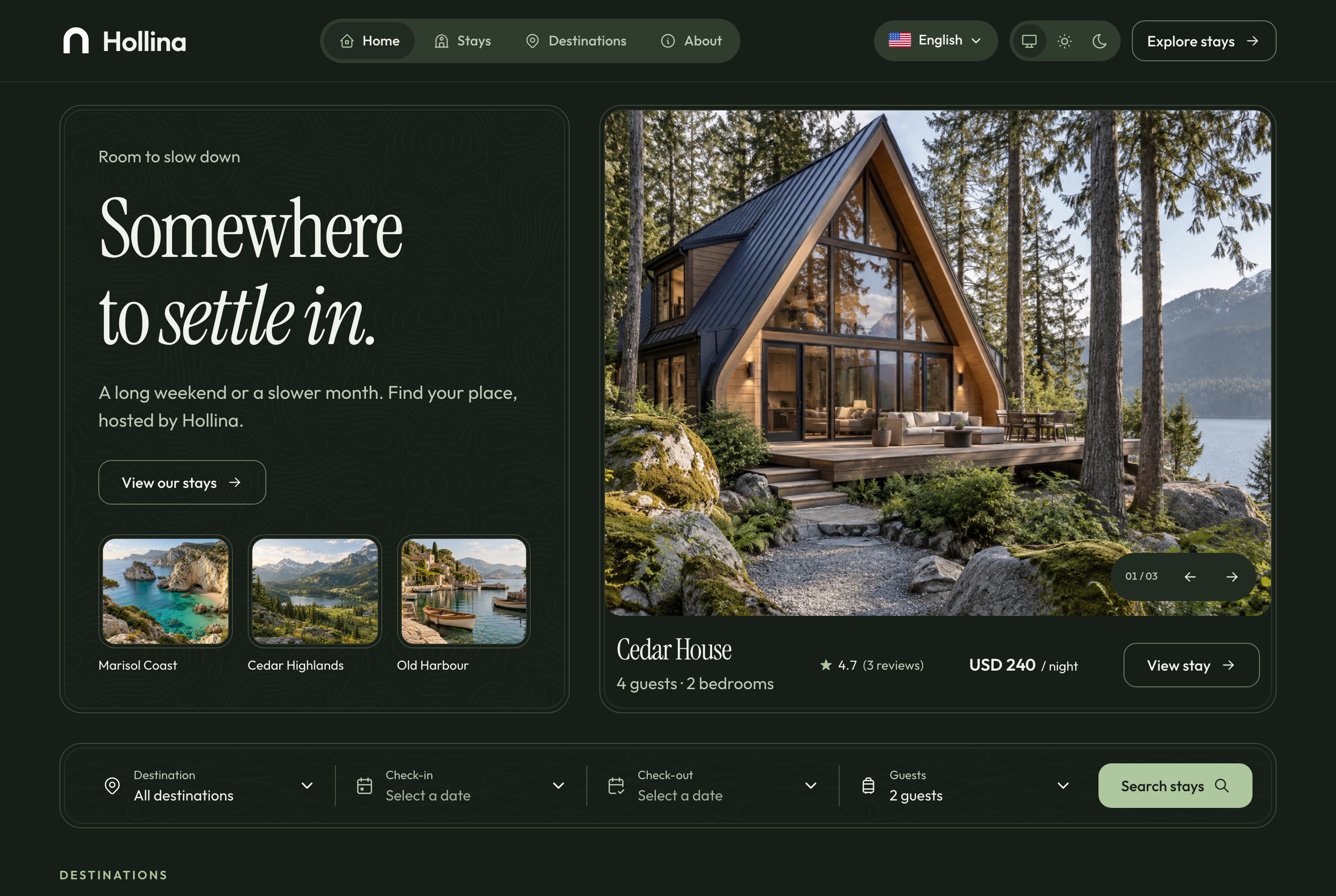
Hollina is a full-stack Next.js vacation rental template made of three apps: a stays website for guests, a booking dashboard for the host's team, and a NestJS API that both of them use. Guests search stays by destination, dates, guests and type, with every filter kept in the address bar, so a search can be shared or reopened with the back button. A stay page shows the gallery, amenities, house rules, reviews and a two-month availability calendar, and prices the nights, the cleaning fee and the total as the guest picks a check-in and a check-out.
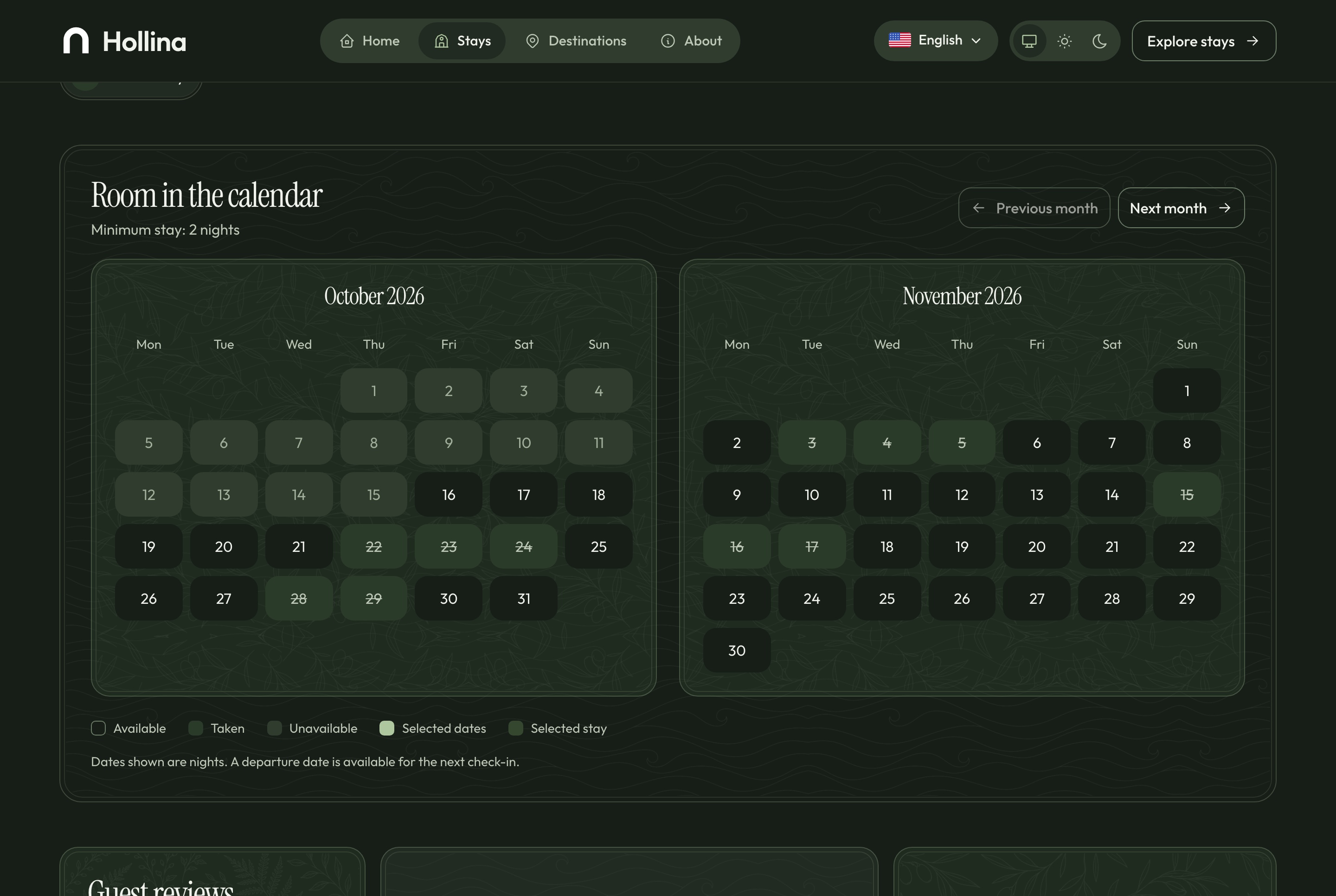
One availability service in the API answers every question about free dates, so the website, the checkout, the dashboard calendar and the AI assistant never disagree about a night. The check-out day stays free for the next arrival, and blocked dates and minimum stays are respected. At checkout the guest pays by card through Stripe's hosted Checkout, with a PayPal account through PayPal Orders v2, or on arrival. The dates are held for 30 minutes while the guest pays, and a signed webhook, not the guest's return to the site, is what confirms a paid booking. A simulator stands in for both processors in a build without keys.
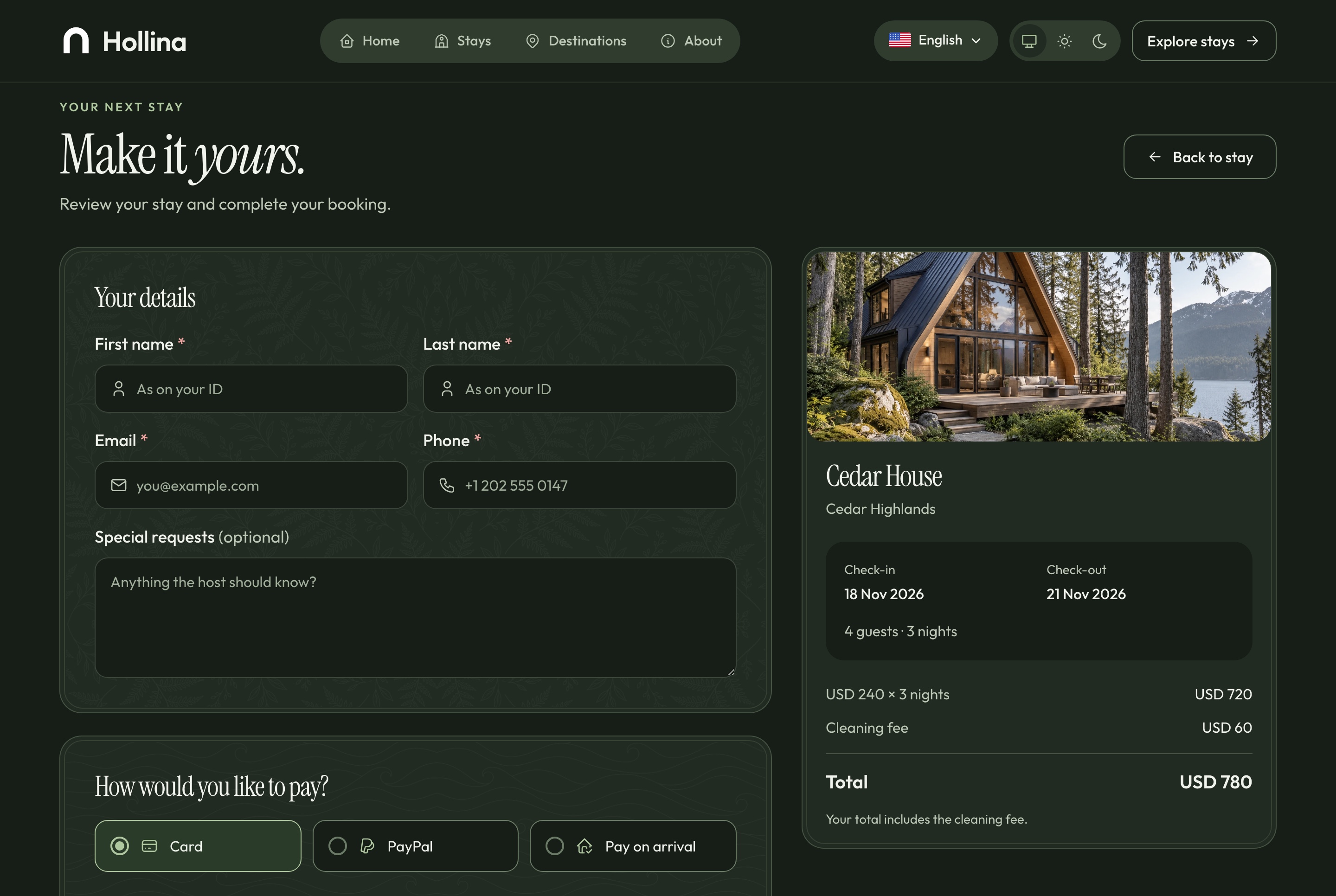
After the stay is booked, the guest finds it by its reference and the email it was made with, with no account needed. While check-in is at least seven days away the guest can cancel it from that page, and a paid booking becomes refund pending for the host to refund from the processor's dashboard. Once the stay is over, the guest can review it, and only a completed booking can leave a review.
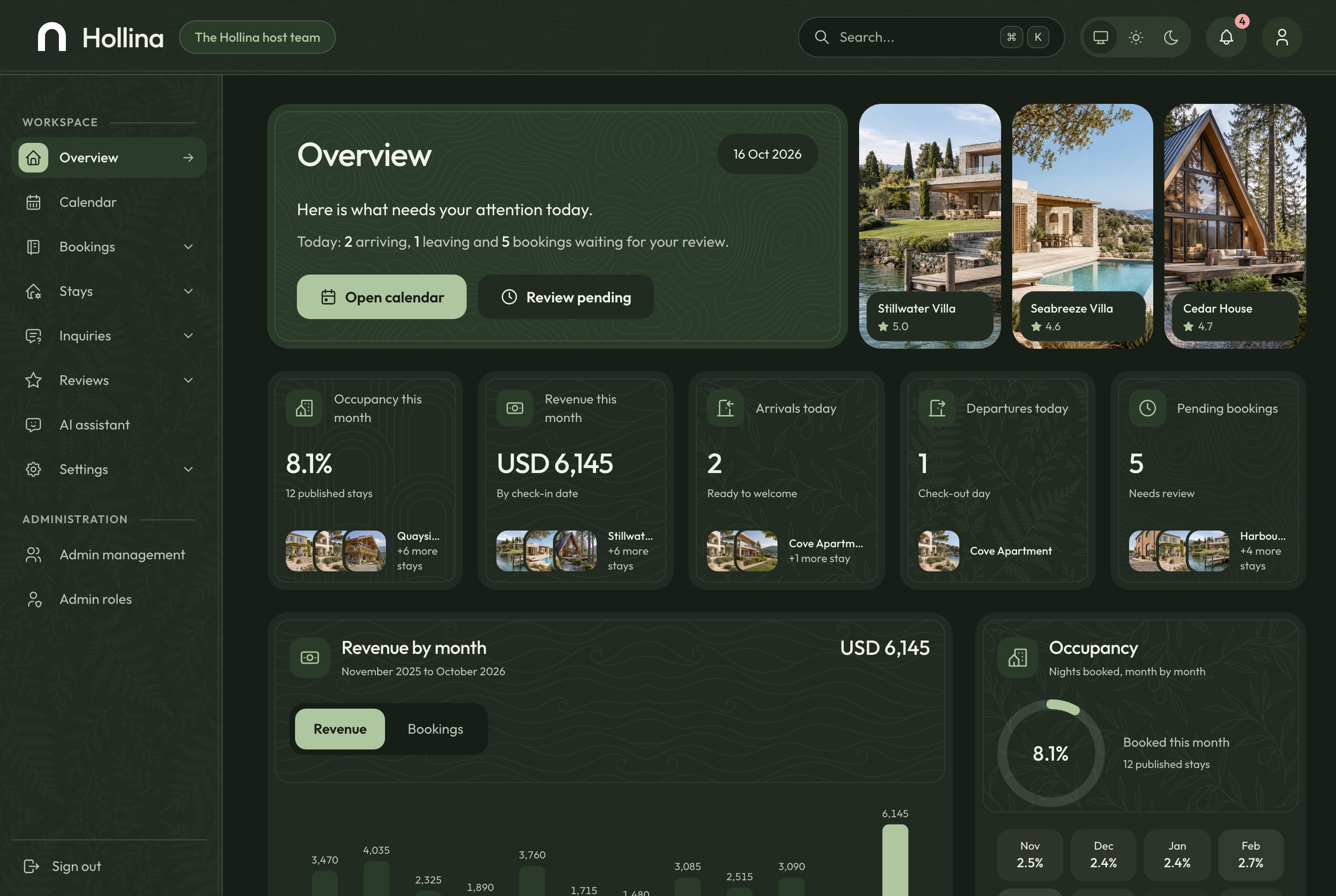
The booking dashboard is where Hollina differs most from a template that only shows stays. The overview opens on this month's occupancy and revenue, today's arrivals and departures, and the bookings waiting for a decision. A month calendar draws every booking as a bar across its nights, one row per stay, and lets the team block dates for maintenance or company use; a block that overlaps a booking is refused with the reason. Each booking moves through confirm, check in, complete or cancel, and an action that is not available says why, so an unpaid card booking cannot be confirmed by mistake.
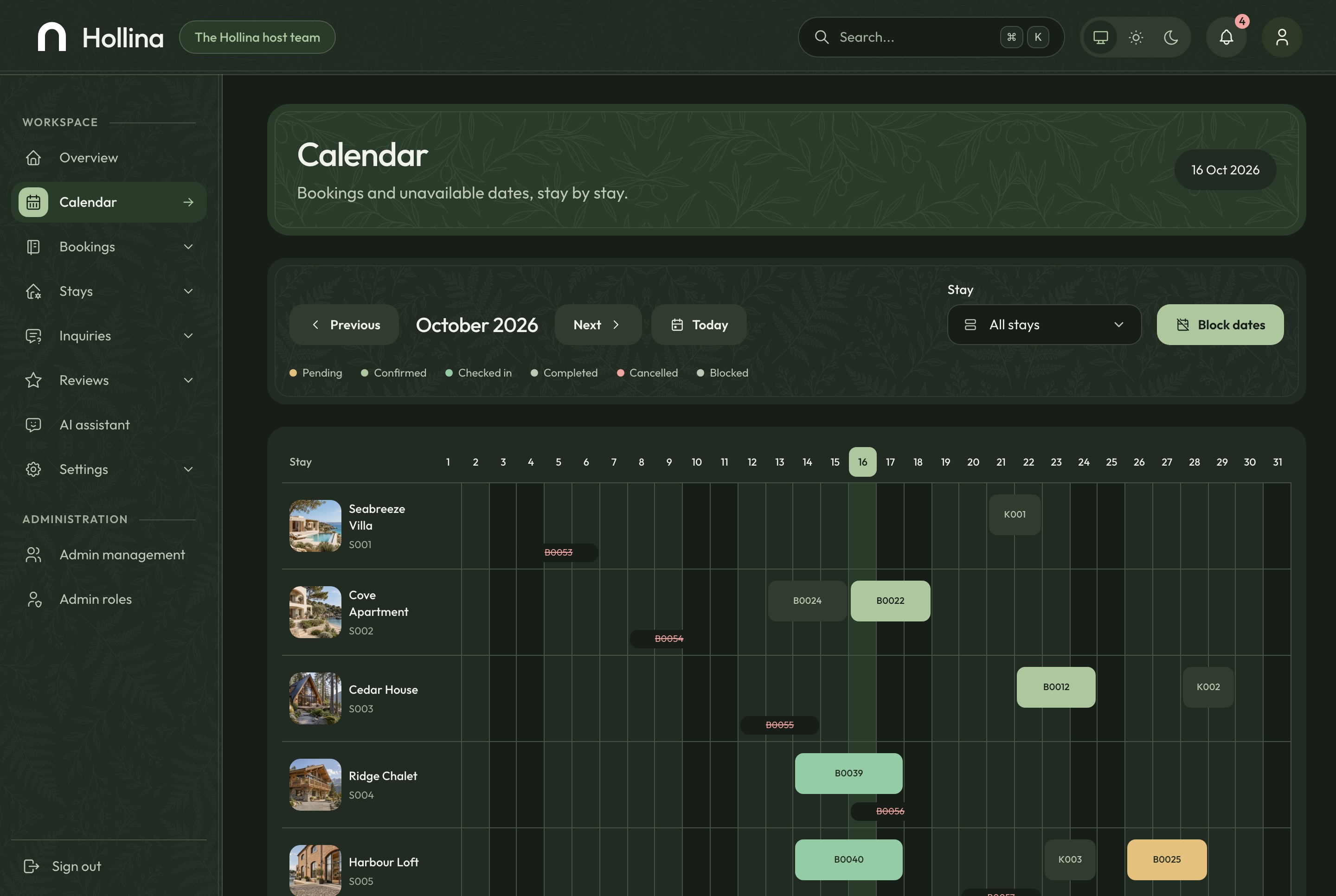
The team edits stays in English and Arabic under language tabs, with photos in display order, and a stay is published only with three photos and both languages filled in. Inquiries from the contact form and the stay page arrive with a status and internal notes, and reviews can be hidden or published again, with the stay's rating following each change. An AI assistant answers questions about availability, bookings and revenue from the company's own data through 27 MCP tools, draws a chart for trend questions, and can block dates or move a booking along. It runs on Google Gemini with your own key.
- Stays website: a nine-section home page, stays list, stay pages, checkout, booking lookup, saved stays, destinations, about and contact
- Two-month availability calendar and a live quote on every stay page
- Stripe hosted Checkout, PayPal Orders v2 and pay on arrival, with signed webhooks that confirm, fail and refund
- Booking dashboard with overview, month calendar, blocked dates, bookings, stays, inquiries, reviews, team, roles and settings
- NestJS API with TypeORM on SQLite or MySQL, JWT sign-in, 32 permissions, Socket.io notifications and an MCP server
- A seeder that creates a demo company with 14 stays, 6 destinations, 60 bookings, inquiries and reviews
Stack: Next.js 16 App Router, React 19, TypeScript, Tailwind CSS 4, TanStack Query, React Hook Form with Zod, next-intl, NestJS 11, TypeORM, Socket.io, Stripe and PayPal.
Price (checked November 2026): the Full Stack package with all three apps is $149, less than the $187 the parts cost separately. The parts are sold on their own too: the stays website is $39, the booking dashboard is $49 and the Backend API is $99. It is a one-time payment, and the licence covers unlimited commercial projects, client work included.
Good to know: the website and the dashboard read their data from the Hollina API, so if you buy one of them alone you still need the Backend API (or the Full Stack package) for real bookings. You host the API yourself, and Stripe, PayPal and Gemini run on your own accounts and keys, so their fees are billed to you. It is built for one host company, not a marketplace of many hosts. The product page lists what is not included: guest accounts and transactional email, seasonal rates, discount codes, channel sync with Airbnb or Booking.com, maps, several currencies and payouts to owners. The documentation covers a one-command Docker setup, a setup without Docker and each package on its own.
Links: Website demo · Booking dashboard demo · Product page
2. Chisfis on ThemeForest
Best for: a developer who wants the largest set of polished booking pages in current Next.js, covering stays, experiences, car rental and real estate, and who will build or connect the backend.
Chisfis is an online booking template by BooliiTheme, an Elite Author on Envato, with an Airbnb-style look. It has landing pages for stays, experiences, car rental and real estate, category pages in grid and map views, listing detail pages, host profiles, a blog, a ten-step add-listing flow, checkout and confirmation pages (plus a flight checkout), an account area and sign-in screens. The latest release, version 2.4.0 from October 26, 2026, carries search, filters and bookings through the results, listing, checkout and confirmation pages, and adds six currencies and an HTML version of the template.
The listing is plain about what it is: "No backend," with "no database and no service to sign up for." Forms, likes, filters and checkout "run on local state," and each one names the function or address to replace when you connect a real API. A right-to-left layout can be switched on from the Customize panel.
- Stays, experiences, car rental and real estate landing pages
- Grid and map category views on MapLibre
- Ten-step add-listing flow and host profiles
- Checkout, confirmation and account pages
- RTL layout switch and six currencies
Stack: Next.js 16.3.5 App Router, React 19.3, TypeScript 5.9, Tailwind CSS 4.3, Headless UI, Radix UI, MapLibre GL. Last updated October 27, 2026, according to the product page.
Price (checked November 2026): $39 for a Regular licence on ThemeForest, with 927 sales shown on the listing. The Envato Regular licence covers one end product that users are not charged for.
Good to know: Chisfis does more than Hollina on the guest-facing side: more listing types, map views, a host listing flow and several currencies. What it does not have is the other half: no availability store, no payments, no booking records and no host dashboard. Budget for an API, a database and a payment provider. Arabic is not listed, so plan the translation even though the layout can mirror.
Links: Live preview · ThemeForest page
3. Aquarelle on ThemeForest
Best for: a small hotel or guesthouse that sells rooms rather than whole homes, wants Stripe payments, and is happy to manage content in a headless CMS.
Aquarelle is a hotel booking template by bslthemes, an Elite Author on Envato, built on Next.js with Directus as its headless CMS. Its listing describes a "Dynamic Rooms Management and Calendar based Booking System": guests search room availability, fill in a booking form and pay. Directus is the admin panel, where staff manage rooms with their types, amenities and services, pages, the blog, menus, bookings and reservations, settings and the email templates.
Payments go through Stripe, and version 1.2 added a pay on arrival (cash) option to the booking form. The listing also names booking and contact email templates, a MailChimp newsletter, a REST API, demo data, an SQLite database, and deployment to Vercel or Netlify.
- Room availability search and a calendar-based booking form
- Stripe payments and pay on arrival
- Directus admin for rooms, bookings, pages, blog and email templates
- Booking confirmation pages and booking emails
- SQLite database and demo data
Stack: Next.js 15+ App Router, React 18+, Bootstrap 5, Directus CMS, SQLite. Last updated August 6, 2026, according to the product page.
Price (checked November 2026): $24 for a Regular licence on ThemeForest, with 28 sales shown on the listing.
Good to know: for the price, Aquarelle is the only ThemeForest pick here with a real booking backend and Stripe. Its admin is Directus's own interface rather than a dashboard designed for a host's day, so occupancy, arrivals and a nights calendar are not described. It is built around hotel rooms, not separate homes in several destinations. It has few sales so far, the stack is a version behind on Next.js and React, and Arabic and RTL are not listed.
Links: Live preview · ThemeForest page
4. Villagio on ThemeForest
Best for: a host with a handful of rentals who prefers WordPress, already lists on Airbnb or Booking.com, and wants calendars kept in sync and seasonal prices without writing code.
Villagio is a vacation rental WordPress theme by mototeam, an Elite Author on Envato. It ships with the MotoPress Hotel Booking plugin, a premium plugin included at no extra cost, which handles availability calendars, seasonal, weekly and monthly rates, and iCal sync with Airbnb, Booking.com and any other service that reads iCal files.
The listing names a long list of payment options: PayPal, Stripe (with Bancontact, iDEAL, Giropay, SEPA Direct Debit and SOFORT), Braintree, 2Checkout and Beanstream, plus payment on arrival and bank transfer. Version 2.3.0, from August 6, 2026, updated the plugin and added an admin calendar where bookings, dates, rates and availability are managed in one place, and a multi-property availability calendar.
- MotoPress Hotel Booking plugin included
- Availability calendars and a multi-property calendar
- Seasonal, weekly and monthly rates
- iCal sync with Airbnb and Booking.com
- Stripe, PayPal, Braintree and more, plus pay on arrival
Stack: WordPress with the MotoPress Hotel Booking plugin. Last updated August 6, 2026, according to the product page.
Price (checked November 2026): $89 for a Regular licence on ThemeForest, with 1,143 sales shown on the listing.
Good to know: Villagio does two things Hollina does not: seasonal rates and calendar sync with the big platforms, which matter most to hosts who also list elsewhere. It is not a Next.js codebase, so it suits a site run from the WordPress admin more than an app a developer extends in TypeScript. The listing names English and German translations; RTL and Arabic are not listed.
Links: Live preview · ThemeForest page
5. Booking Core on CodeCanyon
Best for: a team building a booking marketplace where many hosts or vendors list hotels, spaces, tours or cars, and the platform takes a commission.
Booking Core is a Laravel booking system sold on CodeCanyon. It covers several booking types, with hotel, space, tour, car, event, boat and flight modules referenced in its changelog, and a vendor system with commissions for running a marketplace. Its demo page lists role-based access, a page and menu builder, pricing rules, a booking report with charts, reviews, social sign-in with Google and Facebook, map locations and a built-in translation tool.
Payment gateways named in the changelog include Stripe, PayPal, Paystack, Payrexx and 2Checkout. The listing also mentions iCal sync, multi-language and RTL support, and a mobile API. Version 4.0.0 moved it to Laravel 12 with a new folder structure.
- Hotel, space, tour, car, event and boat booking modules
- Vendor dashboard with commissions
- Several payment gateways and iCal sync
- Multi-language with RTL, page builder and booking reports
- Live sandbox demo
Stack: Laravel 12, PHP 8.2+, MySQL 5.7.8+ or MariaDB. Version 4.0.1 dated August 19, 2025, and last updated October 26, 2025, according to the product page.
Price (checked November 2026): $69 for a Regular licence on CodeCanyon, with 2,871 sales shown on the listing.
Good to know: Booking Core is the most complete multi-vendor platform in this list, and, with Hollina, one of two picks that list full RTL support. It is a PHP application, not a Next.js front end, and its last update was more than a year before this check. The product page also carries a note from the developer asking buyers whether development should continue, so ask about the update plan before you build a business on it.
Links: Live demo · CodeCanyon page
6. TripFinder on ThemeForest
Best for: a developer who needs low-cost rental and listing pages in React and Next.js and has a backend in mind already.
TripFinder is a rental, travel and listing template by RedQ Team, a Power Elite Author on Envato. It is one of the longest-selling templates of its kind, with demos for hotels, boat rentals and listings, a full-width map view for hotels, and Google Maps. The listing describes a search, compare and book flow, and sign-in, sign-up and password screens.
Version 5.4.0 moved the boat demo to Next.js 15.0.1 and the hotel demo to React on Vite, and removed Firebase support from the hotel demo. Version 5.5.0, from January 13, 2025, added React 19 support and updated packages.
- Hotel, boat rental and listing demos
- Search and listing pages with a map view
- Sign in, sign up and forgotten password screens
- Tailwind CSS, Ant Design and styled-components
Stack: React 19, Next.js 15 (boat demo), Vite (hotel demo), TypeScript, Tailwind CSS, Ant Design, React Hook Form, Zod.
Price (checked November 2026): $17 for a Regular licence on ThemeForest, with 1,353 sales shown on the listing.
Good to know: the listing does not describe a backend, a database or a payment provider, so treat the booking flow as screens. The last update was in January 2025, and the hotel demo now runs on Vite rather than Next.js, so check which demo matches the stack you want before you buy. Arabic and RTL are not listed.
Links: Live preview · ThemeForest page
7. VacationHub on GitHub
Best for: developers who want to read how an Airbnb-style app handles listings, reservations and sign-in in Next.js, before building their own.
VacationHub is an open-source "Full Stack Airbnb Clone built with Next js." Its README lists registration and sign-in, property listing and browsing, booking and reservations, search and filtering, and a Leaflet map of property locations. Hosts add a home with "Share your home," and guests search by location, week and number of guests across categories such as beach, countryside and camping.
- Listings with categories, search and filters
- Reservations by date range
- Sign-in with Google or GitHub through NextAuth
- Image uploads through Edge Store
- MIT licence and a public demo
Stack: Next.js 14.2, React 18, TypeScript, Tailwind CSS 3, Prisma with MongoDB, NextAuth, Leaflet, TanStack Query. About 118 GitHub stars, with the last push on September 2, 2025.
Price (checked November 2026): free, under the MIT licence.
Good to know: it is a learning project. The README does not describe a payment step, a host dashboard or availability rules beyond reservations, and the demo's listings are test data. Read it for the data model and the reservation flow, then build on a maintained base.
Links: Live demo · GitHub repository
How to Choose a Vacation Rental or Booking Website Template
1. Decide what booking means for you
Booking templates use the same words for very different things. Sort them into three groups before you compare designs.
- A showcase site. Stays, photos, a map and an "enquire" or "book on Airbnb" button. Any template here can do this, and Chisfis or TripFinder do it with the least work.
- A booking flow without a backend. Chisfis and TripFinder let guests pick dates and reach a checkout page, but nothing checks the calendar, takes payment or saves the booking. That is a fine start if a developer will connect it to an API.
- A working booking system. Nights are checked, payment is taken and the booking reaches the host. Hollina does this for one host company, Aquarelle for a small hotel, Villagio on WordPress, and Booking Core for a marketplace.
2. Check how availability is decided
Double bookings start where two parts of a site answer the same question differently: the calendar shows a night as free while the checkout already sold it. Ask where availability lives and whether every screen reads it from the same place. In Hollina, one service in the API answers for the website, the checkout, the dashboard calendar and the assistant, and unpaid dates are held for 30 minutes while the guest pays. Check how a template treats the check-out day, minimum stays and dates the host has blocked.
3. Check where payment happens and what confirms it
Find out which payment providers are connected and what marks a booking as paid. A booking should be confirmed by the processor's signed webhook, not by the guest landing on a thank-you page, because a guest can close the tab before that page loads. Hollina sends cards to Stripe's hosted Checkout and PayPal accounts to PayPal's own page, so card details never reach your server, and webhooks confirm, fail and refund bookings. Aquarelle and Villagio list Stripe and pay on arrival. Front-end templates show a payment form that still needs a provider behind it.
4. Think about the host, not just the guest
Every booking has to reach someone who prepares the stay. Ask where the host sees today's arrivals and departures, how a booking moves from pending to checked in, and how dates are blocked for cleaning or repairs. Hollina has a dashboard built around a month calendar of nights. Villagio has an admin calendar inside WordPress, Aquarelle manages bookings in Directus, and Booking Core has admin and vendor dashboards. Chisfis, TripFinder and VacationHub have no host side to speak of.
5. Pricing rules and calendar sync
Look at how prices are set. Hollina prices each stay with a nightly rate, a cleaning fee and minimum nights, and lists seasonal rates and discount codes as not included. Villagio's plugin handles seasonal, weekly and monthly rates. If you also list on Airbnb or Booking.com, calendar sync matters more than any design choice: Villagio and Booking Core list iCal sync, and the others do not. Without it, you update two calendars by hand or risk selling the same night twice.
6. Languages and right-to-left layout
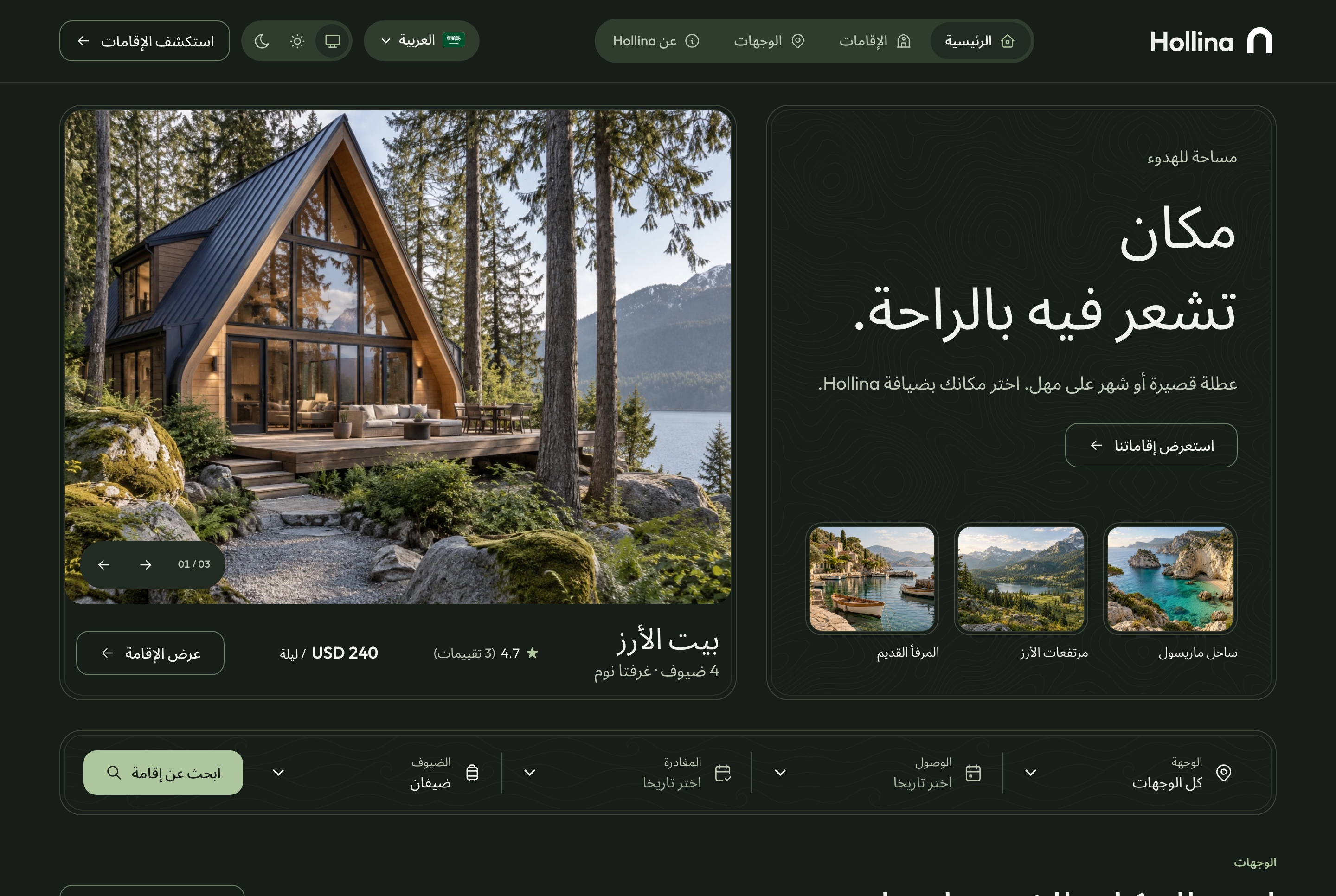
For hosts serving Arabic-speaking guests, translation is only half the job. The layout has to mirror, the date pickers and the checkout have to read right to left, and prices, dates and booking references have to stay readable. Hollina lists English and Arabic with full RTL on both the website and the booking dashboard, with Latin digits for prices and references. Booking Core lists multi-language and RTL support, and Chisfis has an RTL layout switch without a translation. For the others, plan to add the language and the mirrored layout yourself, and test the calendar and checkout, not just the home page.
7. Count the full cost
The template price is the smallest line. A front-end template costs less to buy but more to finish, because a developer has to build availability, payments and the host's screens. A full-stack template costs more up front but needs hosting for its API and database, plus the payment provider's fees. Booking platforms and hosted direct-booking tools charge a commission per booking or a monthly fee instead. Compare a year of each, including the developer time, before you decide.
8. Read the licence and check maintenance
Envato's Regular licence (Chisfis, Aquarelle, Villagio, TripFinder, Booking Core) covers a single end product that users are not charged for, so an agency building sites for several clients needs a licence per site. The Aniq UI licence allows unlimited commercial projects, client work included. VacationHub is MIT. Look at the last update too: Chisfis and Villagio were updated in 2026, while TripFinder and Booking Core were last updated in 2025.
9. When a template is the wrong choice
If nobody on your side writes code and you only need a booking page for a few rentals, a hosted direct-booking tool or the booking site your channel manager already offers is simpler than any template here. If "booking" for you means appointments (a salon, a clinic, a consultant), a scheduling tool or an appointment template fits better than a stays template. A template makes sense when you want your own design and your own data, no commission on each booking, or a site an agency can hand over and keep extending.
Common Mistakes When Choosing a Booking Website Template
Taking a date picker for a calendar
A date picker that lets a guest choose any night is not an availability calendar. Before you buy, look for where taken and blocked nights are stored, not only a screenshot of a calendar.
Trusting the thank-you page
A booking confirmed when the guest returns from the payment page can be lost or faked. Confirmation belongs to the processor's webhook, checked on the server.
Forgetting the host side
A site that takes bookings with no screen for the host means bookings arrive by email or not at all. Decide how the team will see arrivals, block dates and cancel a booking before you choose.
Ignoring cancellations and refunds
Guests cancel. Check whether the template has a cancellation policy, who can cancel and until when, and what happens to a paid booking when it is cancelled.
Skipping the licence check
A Regular licence on Envato limits you to one end product. If you build booking sites for clients, count the licences you need, or choose a licence that covers client work.
FAQ
What is the best vacation rental website template?
If you want guests to book and pay on your own site and your team to run the calendar from a dashboard, Aniq UI Hollina is the most complete Next.js pick in this list, with a stays website, a booking dashboard and a NestJS API in one package.
If you prefer WordPress and need seasonal rates and Airbnb calendar sync, Villagio is the stronger choice. If you only need booking pages and will build the backend yourself, start with Chisfis.
What is the best booking website template for a marketplace?
Booking Core is built for many vendors with commissions and several booking types. Hollina and Aquarelle are built for one business taking its own bookings.
Is there a free vacation rental website template?
VacationHub is free under the MIT licence and covers listings, reservations and sign-in. It has no payment step or host dashboard described in its README, so treat it as a reference. We did not find a free template with payments and a host dashboard that we could recommend.
Which booking template has an availability calendar?
Hollina has a two-month availability calendar on every stay page and a month calendar of nights in the dashboard, both read from the same service. Aquarelle describes calendar-based room booking, Villagio's plugin has availability calendars, and Booking Core manages availability per listing.
Can a booking template sync with Airbnb and Booking.com?
Villagio and Booking Core list iCal sync. Hollina does not include channel sync, so a host who also lists on those platforms keeps the calendars aligned by hand or adds sync.
Which booking templates support Arabic and RTL?
Among the picks here, Hollina lists English and Arabic with a full right-to-left layout on the stays website and the booking dashboard. Booking Core lists RTL support and Chisfis has an RTL layout switch, but Arabic text is work you add yourself with both.
Do I need a backend for a booking website?
Yes, if the site takes real bookings. Something has to store taken nights, take payment, confirm it and tell the host. A front-end template can show all of that, but a backend has to do it.
Conclusion
If you want a booking website that takes real bookings, with an availability calendar, Stripe and PayPal payments, a host dashboard and its own API, in English and Arabic from day one, start with Hollina. You can buy the stays website or the booking dashboard alone, as long as you add the Backend API.
If you mainly need booking pages, Chisfis gives you the widest Next.js set and TripFinder the lowest price. Aquarelle suits a small hotel that wants Stripe and a CMS for little money, Villagio suits a WordPress host who needs seasonal rates and calendar sync, and Booking Core suits a marketplace of many hosts. For learning, VacationHub shows an Airbnb-style app with reservations. You can open both live demos and compare every package on the Hollina product page.
Related guides
- How to Build a Vacation Rental Booking Website with Next.js
- Real Estate Dashboard Templates (2026): Realtor and Property Management
- Restaurant Website Templates with Online Ordering (2026)
- Best Next.js Templates for 2026: Free and Premium Picks
- Best Admin Dashboard Templates by Industry in 2026
- Best RTL Admin Dashboard Templates with Arabic Support (2026)
- Best Next.js Landing Page Templates for 2026 (Free and Premium)
Sources
- Aniq UI Hollina product page
- Chisfis on ThemeForest
- Aquarelle on ThemeForest
- Villagio on ThemeForest
- Booking Core on CodeCanyon
- Booking Core demo
- TripFinder on ThemeForest
- VacationHub on GitHub
- Envato licences on ThemeForest
Checked November 2026.
You might also like
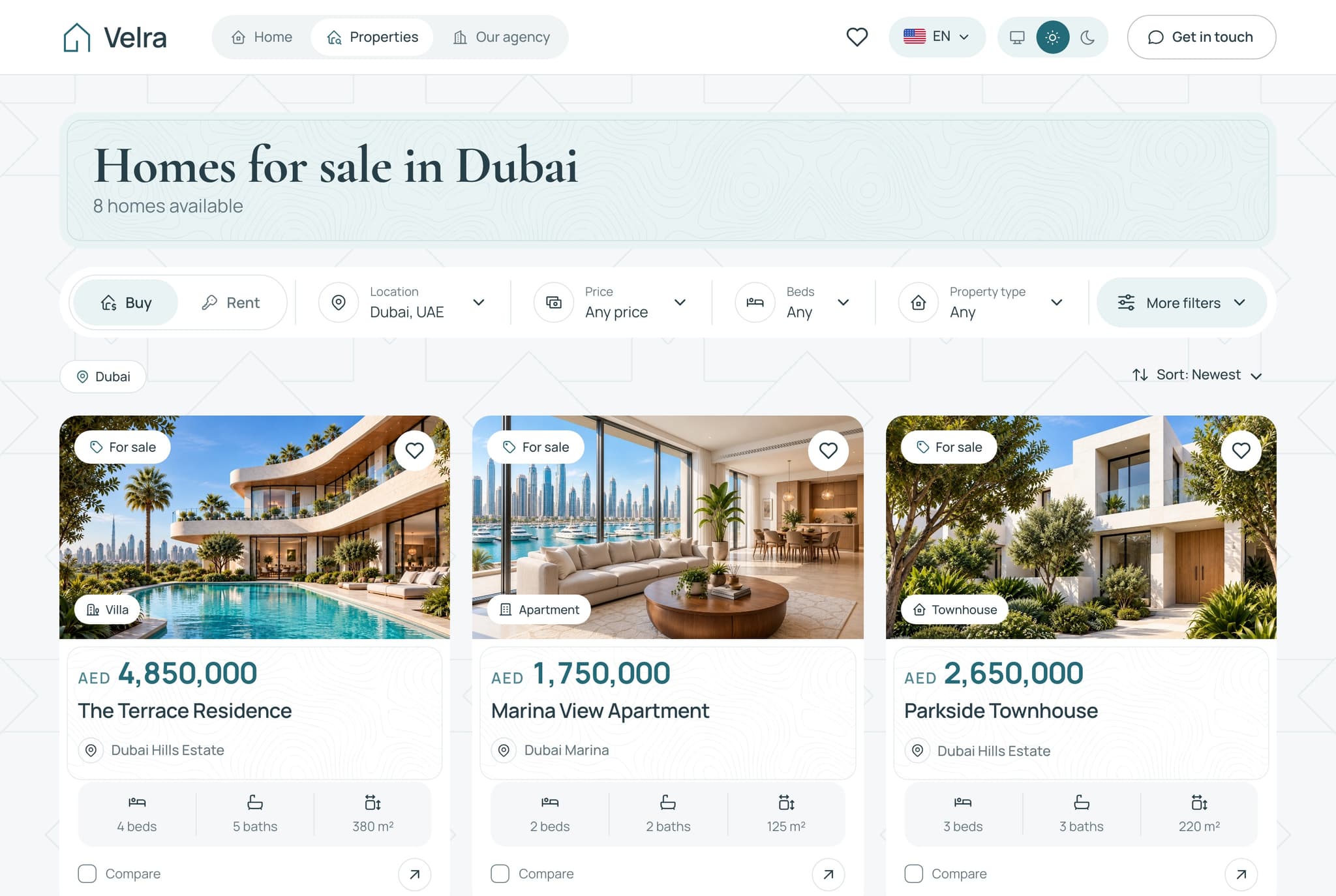
Next.js Website Templates for Small Businesses (2026)
Choose a Next.js website template by business type: restaurant, real estate, courses, shop, rentals, events or services. What to check, picks and prices.
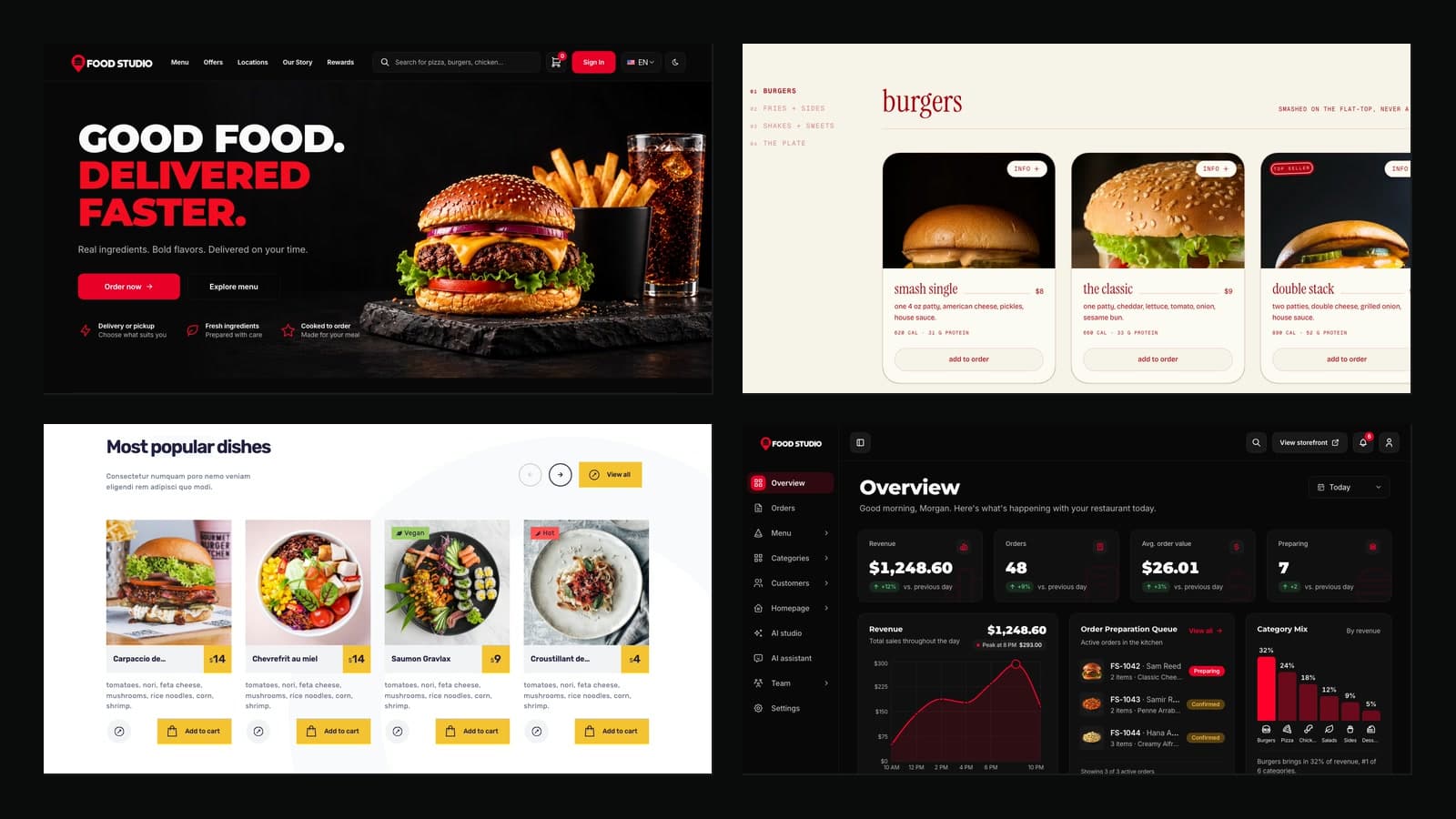
Restaurant Website Templates with Online Ordering (2026)
Compare 7 restaurant website templates with online ordering for 2026: Next.js and React picks, ThemeForest options, free GitHub code and a kitchen dashboard.
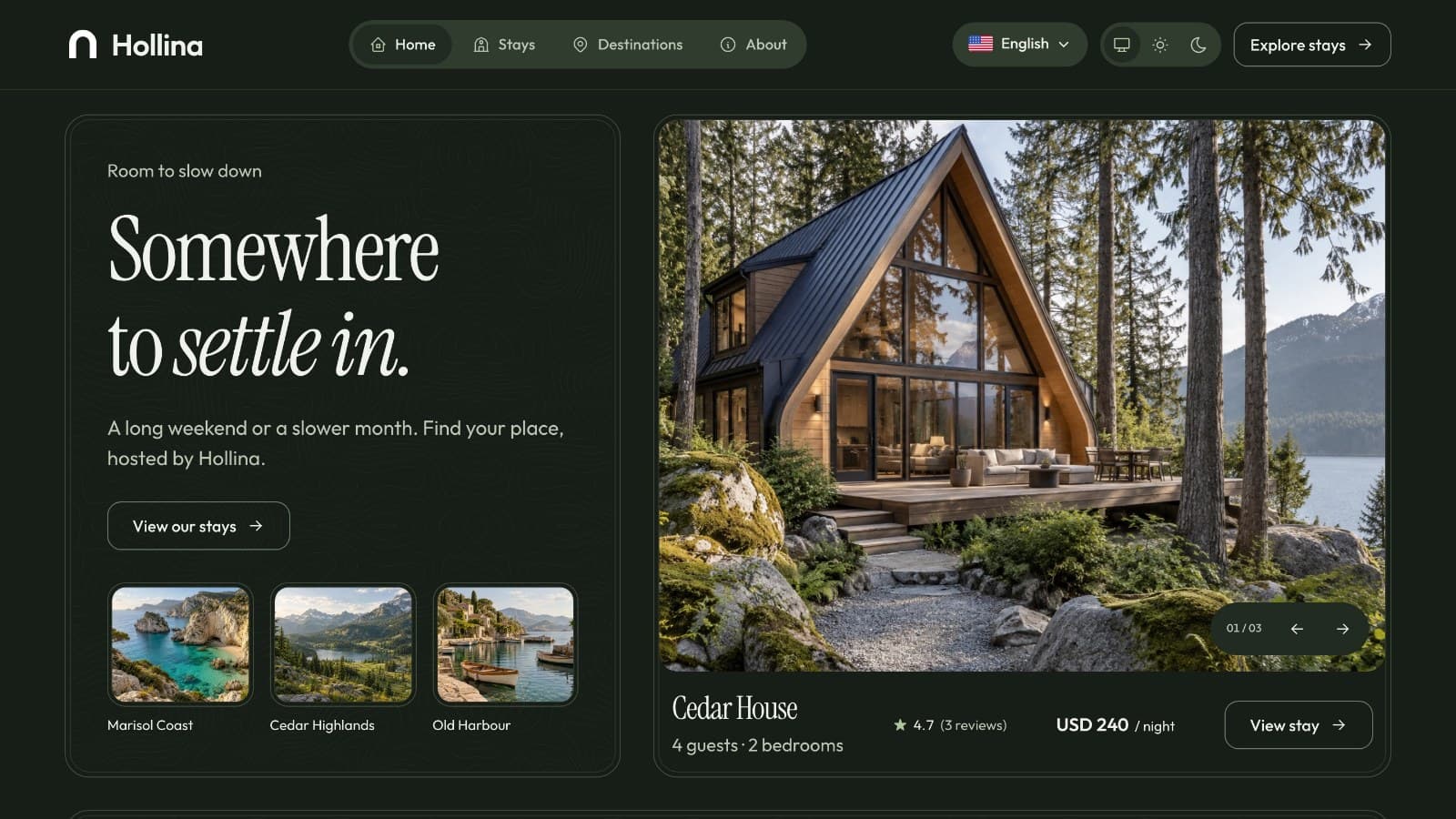
How to Build a Vacation Rental Booking Website with Next.js
Build a vacation rental website with direct booking in Next.js: add stays, protect the calendar, set up Stripe and PayPal, and go live.
