Top 10 Best Next.js Admin Dashboard Templates for 2026
Compare the best free & premium Next.js admin dashboard templates for 2026, built with Next.js 16, React 19, Tailwind CSS, shadcn/ui and TypeScript.
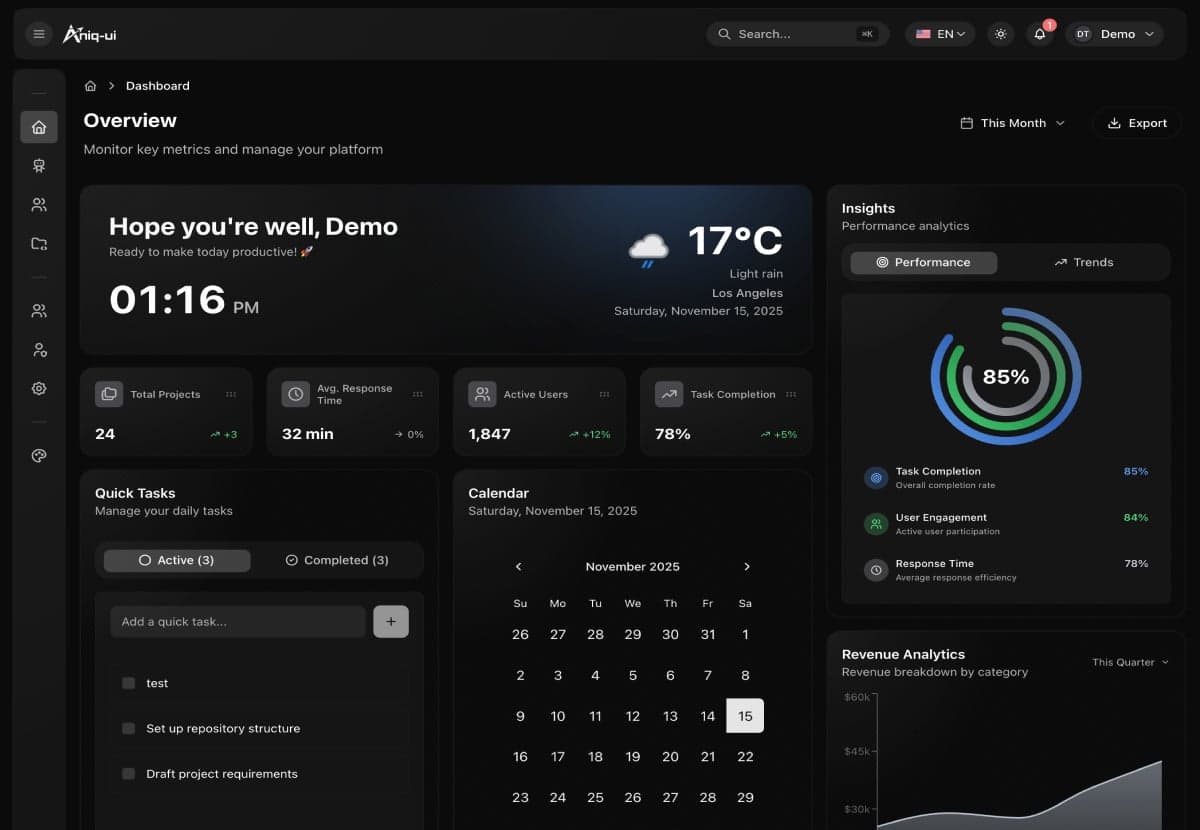
Building a modern admin dashboard from scratch means solving layout, navigation, tables, charts, authentication states, responsive behavior, dark mode, accessibility, and data-loading patterns at the same time. This June 2026 refresh focuses on current Next.js dashboard templates for SaaS founders, front-end developers, and agencies shipping admin panels, fintech dashboards, internal tools, CRM/ERP systems, and AI-enabled control centers.
Originally published in 2025. Updated in June 2026 with refreshed rankings, Next.js 16 notes, React 19 compatibility checks, Tailwind CSS v4 updates, and newer template positioning.
| Template Best For Backend AI RTL |
| Aniq UI Admin Dashboard Template 2 | Best overall full-stack dashboard | Optional NestJS backend | Included | Arabic RTL support |
| Aniq UI Financial Dashboard | Best finance dashboard | Frontend template | Not listed | Arabic RTL support |
| TailAdmin | Best free Tailwind dashboard | Frontend template | AI-related dashboard categories in the broader TailAdmin ecosystem | Not the main focus |
| NextAdmin | Best broad free admin starter | Database/auth-oriented examples | Not the main focus | Not the main focus |
| Modernize | Best MUI dashboard | No backend by default / varies by package | Not the main focus | Check package |
| Materio | Best premium MUI alternative | Auth/database integrations vary by package | Not the main focus | Premium MUI Store listing includes RTL support |
| Vercel Admin Dashboard | Best deployable Vercel starter | Vercel Postgres + Auth.js | Not the main focus | Not the main focus |
| HeroUI Dashboard / HeroUI Pro | Best component-library direction | No backend by default | Pro includes AI tooling | Component-level support depends on implementation |
| TailAdmin Pro | Best Tailwind component library upgrade | Frontend template | AI dashboard categories available | Check package |
| Dashcode / Materialize / Horizon UI | Best legacy/broad commercial options | Varies | Varies | Varies |
- Best overall full-stack dashboard: Aniq UI Admin Dashboard Template 2.
- Best finance dashboard: Aniq UI Financial Dashboard.
- Best free Tailwind dashboard: TailAdmin.
- Best broad free admin starter: NextAdmin.
- Best MUI dashboard: Modernize.
June 2026 Update: What Changed Since the 2025 List?
The biggest change is that Next.js 16 is now the baseline for several actively maintained dashboard starters. The Next.js 16 release introduced Cache Components, made Turbopack the default bundler for apps, renamed the Middleware file convention to proxy.ts, and updated caching APIs such as revalidateTag() and updateTag(). (nextjs.org)
React 19 is also the expected React baseline in many current templates. React owns hooks such as useOptimistic and useActionState, while useFormStatus is provided by react-dom for form submission state. (react.dev)
Tailwind CSS v4 is another important dashboard-template shift. Tailwind’s upgrade guide describes v4 as a new major version and notes that its upgrade tool requires Node.js 20 or higher. (tailwindcss.com)
For 2026, this buying guide focuses on practical selection questions:
- Which Next.js admin dashboard template should I choose?
- Which templates are free vs premium?
- Which ones are current for 2026?
- Which stack is best for SaaS, fintech, CRM, AI dashboards, or internal tools?
- What should I check before using a template in production?
Why Choose Next.js for Admin Dashboards?
Next.js works well for dashboards because the App Router supports server-rendered application architecture and interactive React UI. In Server Components, you can fetch data with async I/O such as fetch, an ORM, or a database client, then pass data to Client Components where browser interactivity is needed. (nextjs.org)
For dashboards, that usually means:
- Server Components for route-level data reads, layout, and non-interactive UI.
- Client Components for charts, filters, editable tables, modals, and command palettes.
- Route Handlers for custom endpoints, webhooks, exports, and internal API utilities.
- Server Actions for mutations when they fit your data flow.
- A design system so buttons, cards, tables, modals, and form states stay consistent.
Route Handlers use the Web Request and Response APIs and support HTTP methods including GET, POST, PUT, PATCH, DELETE, HEAD, and OPTIONS. (nextjs.org)
For image-heavy dashboards, the Next.js Image component extends the native <img> element with automatic image optimization, which is useful for avatars, product thumbnails, media libraries, and CMS-style admin interfaces. (nextjs.org)
Best Next.js Admin Dashboard Templates in 2026
1. Aniq UI Admin Dashboard Template 2
Category: Best overall full-stack dashboard
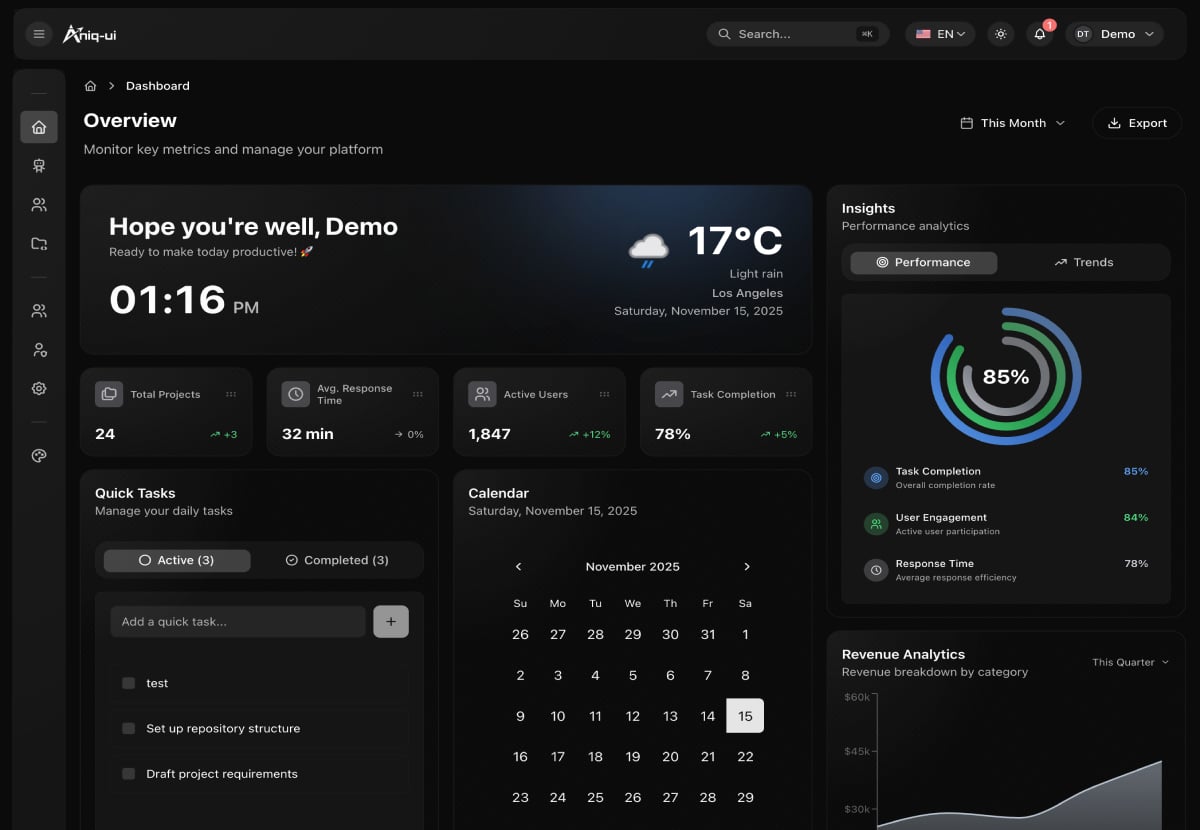
Aniq UI Admin Dashboard Template 2 is a premium, production-ready dashboard built around Next.js 16, React 19, Tailwind CSS 4, TypeScript, TanStack Query, Framer Motion, and a NestJS backend option. The product page lists frontend-only, backend-only, and full-stack license options, with the full-stack option including a NestJS API, TypeORM, authentication, and RBAC. (aniq-ui.com)
Demo video:
Best for: SaaS platforms, CRM/ERP systems, AI-enabled dashboards, internal admin panels, and teams that want frontend and backend foundations together.
Current Aniq UI proof points:
- Updated for Next.js 16 / React 19 / Tailwind CSS 4.
- Includes frontend + optional NestJS backend.
- Includes JWT authentication, RBAC, TypeORM, WebSocket support, and REST APIs.
- Supports English and Arabic, including RTL-ready Arabic support.
- Includes an MCP-compatible AI assistant with model-provider support. (aniq-ui.com)
Tech stack:
- Next.js 16 App Router
- React 19
- TypeScript
- Tailwind CSS 4
- Radix UI
- Framer Motion
- TanStack Query
- Redux Toolkit
- React Hook Form + Zod
- Recharts
- NestJS
- TypeORM
- JWT authentication
- WebSocket gateways
Why it stands out in 2026: most dashboard templates give you UI screens. This one is more useful when you also need backend structure, authentication, roles/permissions, live notifications, multilingual support, and AI assistant foundations in the same starter.
2. Aniq UI Financial Dashboard
Category: Best finance dashboard
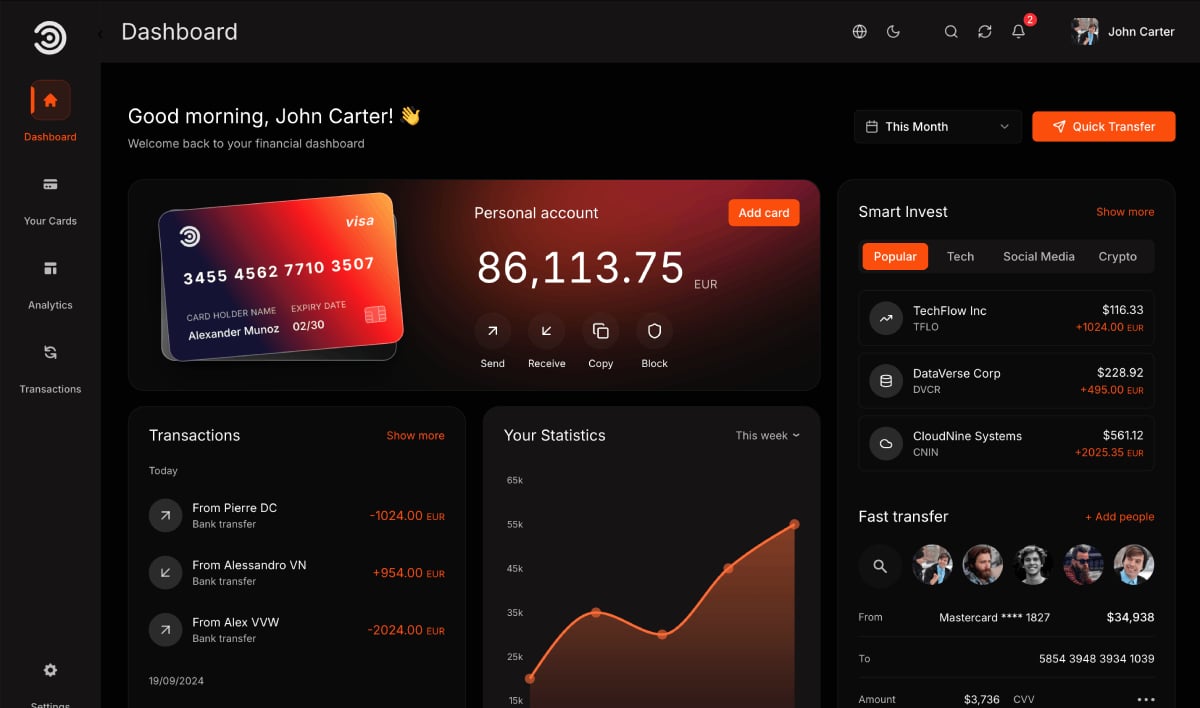
Aniq UI Financial Dashboard is a premium banking and finance dashboard template for fintech apps, investment products, financial management tools, and reporting interfaces. The product page describes it as a Next.js 16 and React 19 financial dashboard with Tailwind CSS 4, next-intl, Redux Toolkit, email authentication, dark/light theme support, transaction tracking, and investment monitoring. (aniq-ui.com)
Demo video:
Best for: fintech apps, banking dashboards, investment platforms, finance reporting interfaces, and internal finance tools.
Current Aniq UI proof points:
- Updated for Next.js 16 / React 19 / Tailwind CSS 4.
- Includes next-intl internationalization with English and Arabic support.
- Supports Arabic RTL through the template theme system.
- Includes Redux Toolkit, email authentication, Recharts, transaction views, investment widgets, and reusable UI components. (aniq-ui.com)
Tech stack:
- Next.js 16
- React 19
- TypeScript
- Tailwind CSS 4
- next-intl
- Redux Toolkit
- React Redux
- React Hook Form + Zod
- Recharts
@tanstack/react-table@dnd-kit
Why it stands out in 2026: a finance dashboard usually needs a more specific information architecture than a generic admin starter. Starting with finance-oriented cards, transactions, analytics, investment widgets, and multilingual/RTL behavior can reduce redesign work.
3. TailAdmin
Category: Best free Tailwind dashboard
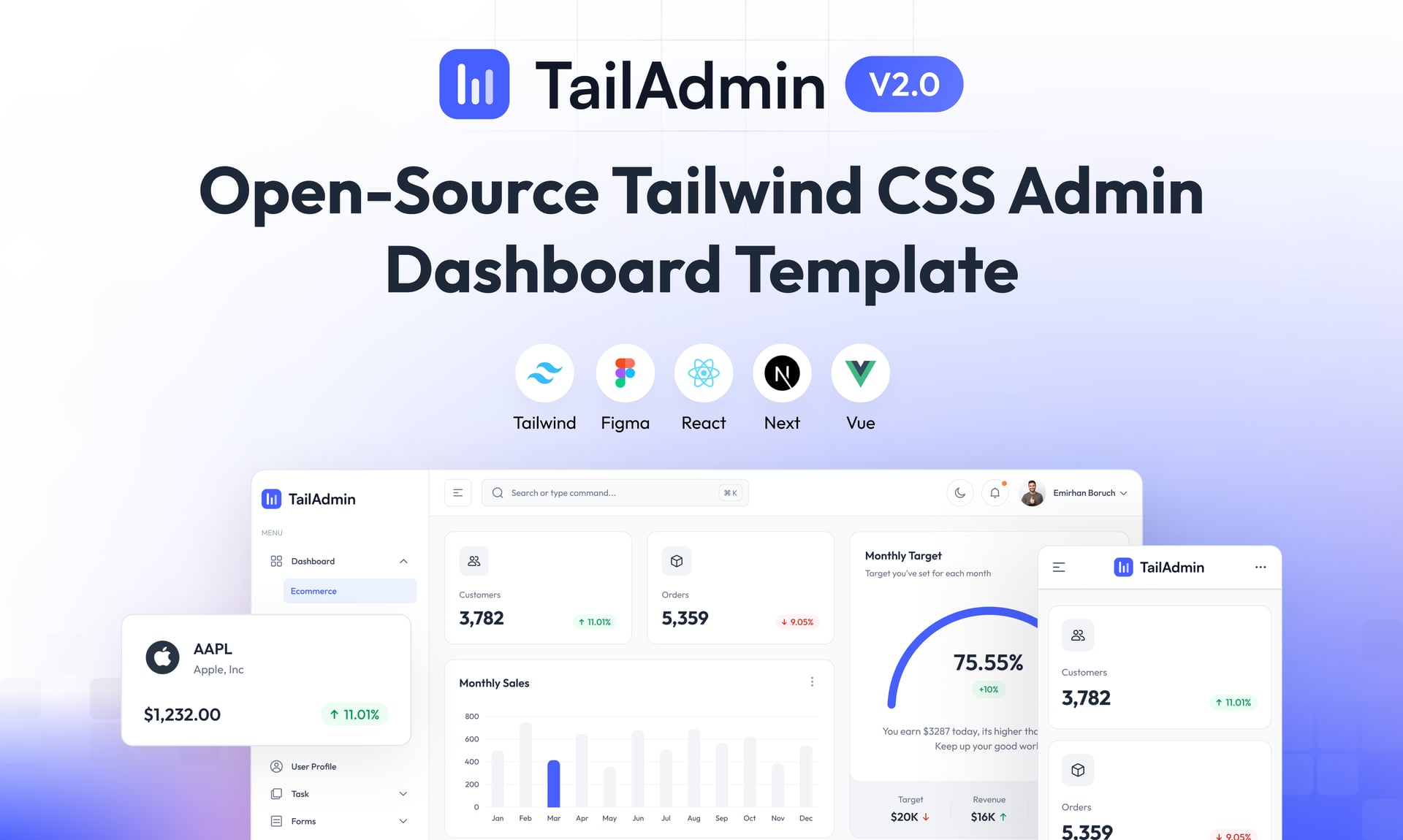
TailAdmin Next.js is a free and open-source admin dashboard template built with Next.js and Tailwind CSS. Its GitHub README lists Next.js 16.x, React 19, TypeScript, and Tailwind CSS v4 as the core stack. (github.com)
Best for: developers who want a free Tailwind-based dashboard starter with charts, auth pages, UI elements, dark mode, and a familiar admin layout.
Tech stack:
- Next.js 16.x
- React 19
- TypeScript
- Tailwind CSS v4
Key features:
- Free and open-source dashboard starter
- Dashboard components and UI elements
- Sidebar layout
- Dark mode support
- Charts and tables
- Mobile responsive layout
- App Router-oriented structure
June 2026 note: TailAdmin’s changelog shows continued updates into 2026, including Next.js 16 compatibility work, React 19 readiness, Tailwind CSS v4 upgrades, and newer dashboard categories such as AI, sales, and finance. (tailadmin.com)
4. NextAdmin
Category: Best broad free admin starter**
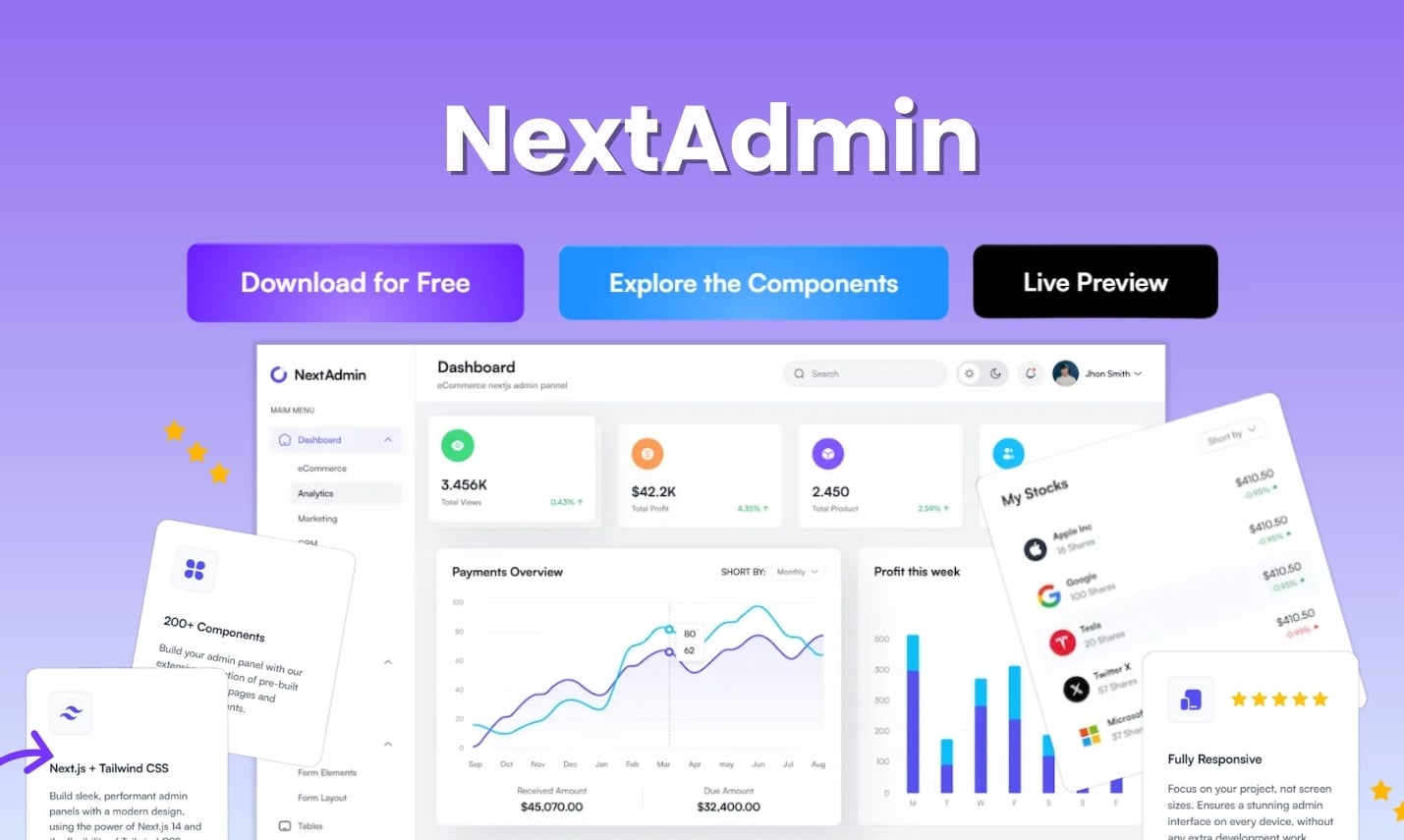
NextAdmin is a free, open-source Next.js admin dashboard toolkit. Its official site describes a toolkit with 200+ UI components, templates, and prebuilt admin pages, using Next.js 16.2.x and Tailwind CSS. (nextadmin.co)
Best for: SaaS dashboards, CRM panels, e-commerce admin areas, and projects that need many prebuilt UI pieces.
Tech stack:
- Next.js 16.2.x
- Tailwind CSS
- TypeScript
- Authentication-oriented examples
- Database-oriented examples
Key features:
- 200+ UI components, templates, and prebuilt admin pages
- Multiple admin-panel templates
- Authentication-oriented examples
- Database-oriented examples
- Components for settings, file management, pricing tables, errors, teams, calendars, profiles, invoices, and more (nextadmin.co)
June 2026 note: NextAdmin is stronger as a broad admin starter than as a highly opinionated full-stack SaaS system. If you already have your backend and auth decisions, it can be a practical UI foundation.
5. Modernize
Category: Best MUI dashboard
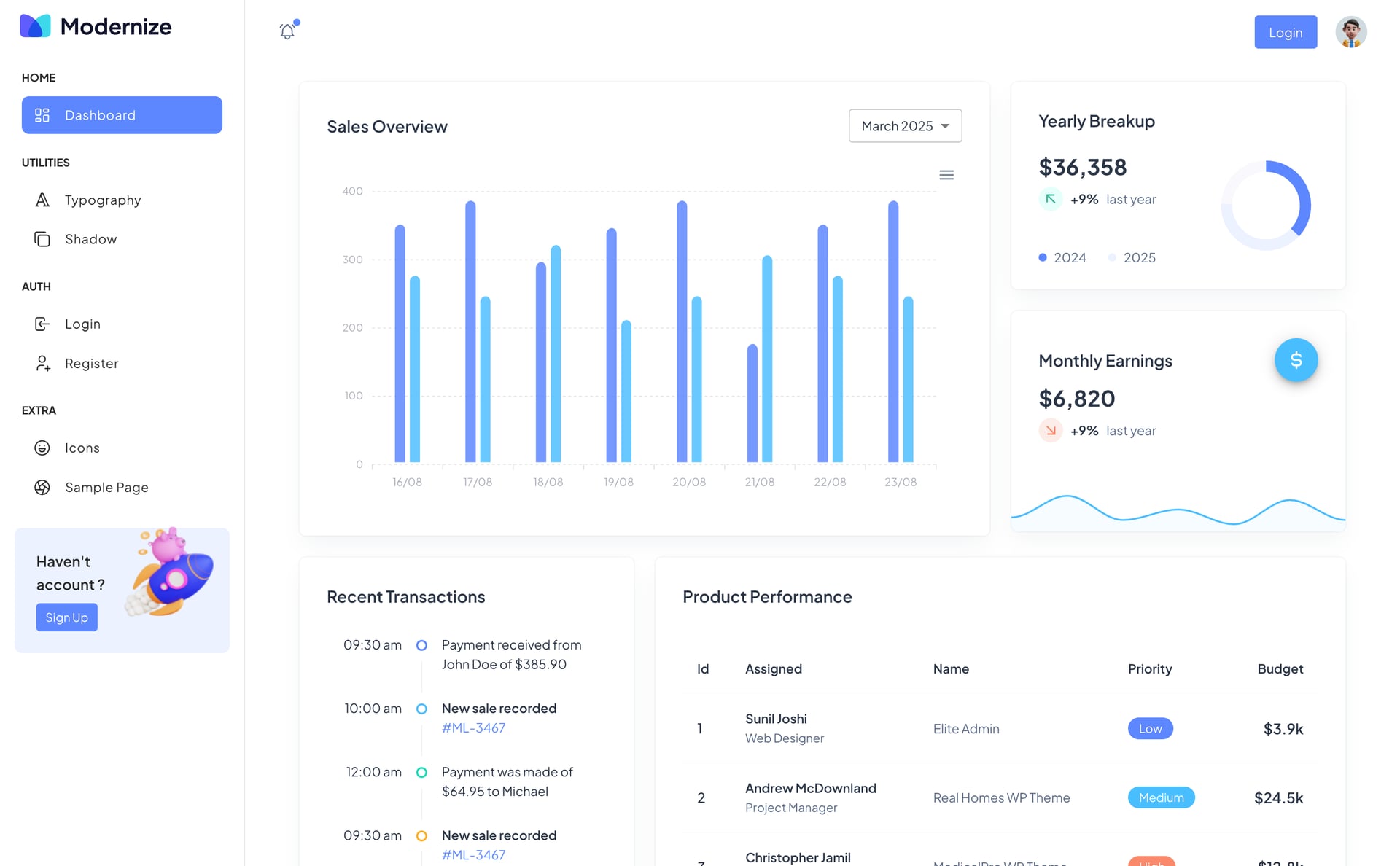
Modernize is an MUI-style React and Next.js admin dashboard from AdminMart. The free GitHub repository describes Modernize Next.js Free as a developer-friendly admin dashboard template built with Next.js, MUI, Tailwind CSS, React, and TypeScript. (github.com)
Best for: teams that prefer Material UI design patterns, prebuilt dashboard pages, and an MUI-style component system.
Tech stack:
- Next.js
- React
- MUI
- Tailwind CSS
- TypeScript in supported packages
Key features:
- Material UI-style dashboard UI
- Responsive admin layouts
- Reusable components
- Clean dashboard structure
- Free repository plus premium product options
June 2026 note: Modernize is a good fit if your product design is already close to Material UI. The MUI Store listing for Modernize’s paid product lists React 19 and Next.js 16 with App Router in premium packages, so compare the free and paid versions before committing. (mui.com)
6. Materio
Category: Best MUI dashboard alternative
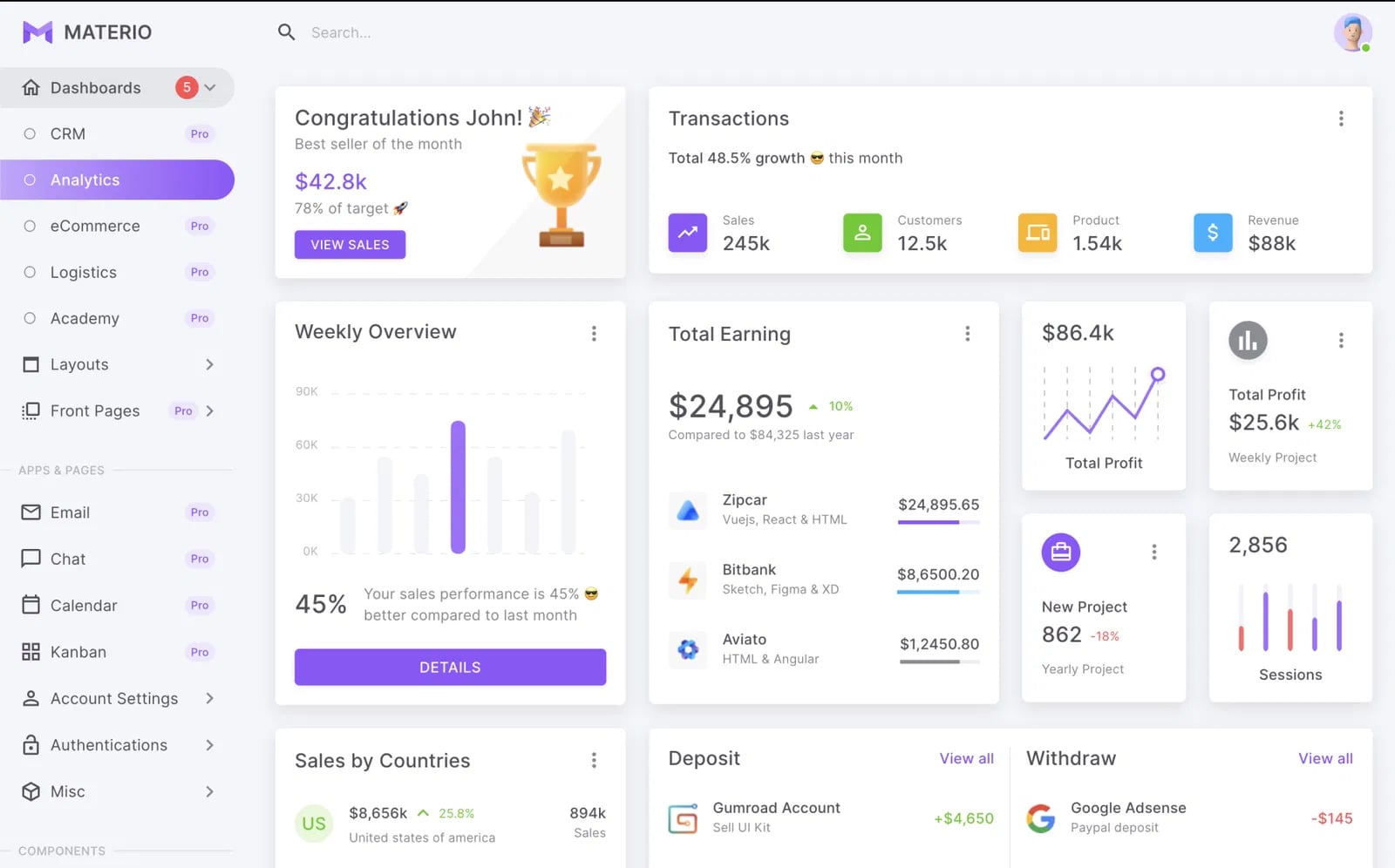
Materio is a Material UI Next.js admin template from ThemeSelection. The free GitHub package has historically been a lighter starting point, while the premium MUI Store listing positions the paid product as a Next.js v16 App Router admin template built with Material UI v7. (mui.com)
The premium MUI Store listing for Materio includes RTL support, multilingual support, NextAuth integration, charts, dashboards, apps, and TypeScript source in selected package tiers. (mui.com)
Best for: MUI-based dashboards where you want Material Design patterns and a structured admin template.
Tech stack:
- Next.js
- Material UI
- Tailwind CSS
- TypeScript
- JavaScript support in some packages
- ESLint and Prettier
Key features:
- App Router support in the premium package
- MUI + Tailwind CSS integration
- TypeScript and JavaScript package options
- Responsive layout
- Organized folder structure
- Premium package options with more dashboards and app flows
June 2026 note: distinguish between the free package and the premium MUI Store package. They do not advertise the same Next.js baseline.
7. Vercel Admin Dashboard
Category: Best deployable Vercel starter
Vercel’s Admin Dashboard Template is a free starter repository for an admin dashboard. The GitHub README describes it as a Next.js 15 Admin Dashboard Template built with the App Router, TypeScript, Auth.js, Postgres, Vercel, Tailwind CSS, shadcn/ui, Vercel Analytics, and Prettier. (github.com)
Best for: developers who want a deployable Vercel-oriented starter with database, auth, and product-table examples.
Tech stack:
- Next.js App Router
- TypeScript
- Auth.js
- Vercel Postgres
- Tailwind CSS
- shadcn/ui
- Vercel Analytics
- Prettier
Key features:
- Product table schema example
- Vercel Postgres setup flow
- GitHub OAuth setup through environment variables
- App Router project structure
- MIT license
June 2026 note: this is useful as a reference or deployable starter, but its README still labels it as a Next.js 15 template. If your target is a fresh Next.js 16 codebase, inspect the package versions and upgrade path before using it. (github.com)
8. HeroUI Dashboard / HeroUI Pro
Category: Best component-library direction
HeroUI is the new identity for NextUI. The official migration guide explains that projects should move package names from @nextui-org/* to @heroui/*, with a codemod available for migration. (v2.heroui.com)
HeroUI v3 is described as a React component library built on Tailwind CSS v4 and React Aria Components. Its v3 release page describes 75+ web components, React Native components, Tailwind CSS v4, React Aria, compound architecture, and HeroUI Pro templates including Dashboard, Mail, Chat, and Finances. (heroui.com)
Best for: teams that want a maintained React component library instead of a static dashboard template.
Tech stack:
- HeroUI v3
- React
- Tailwind CSS v4
- React Aria Components
- HeroUI Pro for premium components/templates
Key features:
- Component-library approach
- Tailwind CSS v4 integration
- React Aria Components foundation
- HeroUI Pro dashboard templates
- Pro components and templates for teams standardizing on HeroUI
June 2026 note: for a new project, do not copy old NextUI dashboard imports. Start with current HeroUI docs or use the migration guide if you are maintaining an older NextUI project.
9. TailAdmin Pro
Category: Best Tailwind component library upgrade
TailAdmin Pro is the premium version of TailAdmin, aimed at teams that need more pages, components, and dashboard variations than the free edition. TailAdmin’s public site describes a broader ecosystem across Next.js and Tailwind dashboard categories such as e-commerce, analytics, marketing, CRM, stocks, SaaS, logistics, AI, sales, and finance. (tailadmin.com)
Best for: teams that like TailAdmin Free but need a larger component library and more dashboard layouts.
Tech stack:
- Next.js
- React
- TypeScript
- Tailwind CSS
Key features:
- More UI and dashboard components than the free version
- Multiple dashboard categories
- Tailwind-based design system
- Premium pages and layouts
- Larger component ecosystem
June 2026 note: TailAdmin Pro is a natural upgrade path if your team starts on TailAdmin Free and wants to stay in the same Tailwind-first design language.
10. Dashcode / Materialize / Horizon UI
Category: Best broad or ecosystem-specific options
This final slot groups several useful options that are better treated as ecosystem-specific picks than default recommendations.
Dashcode
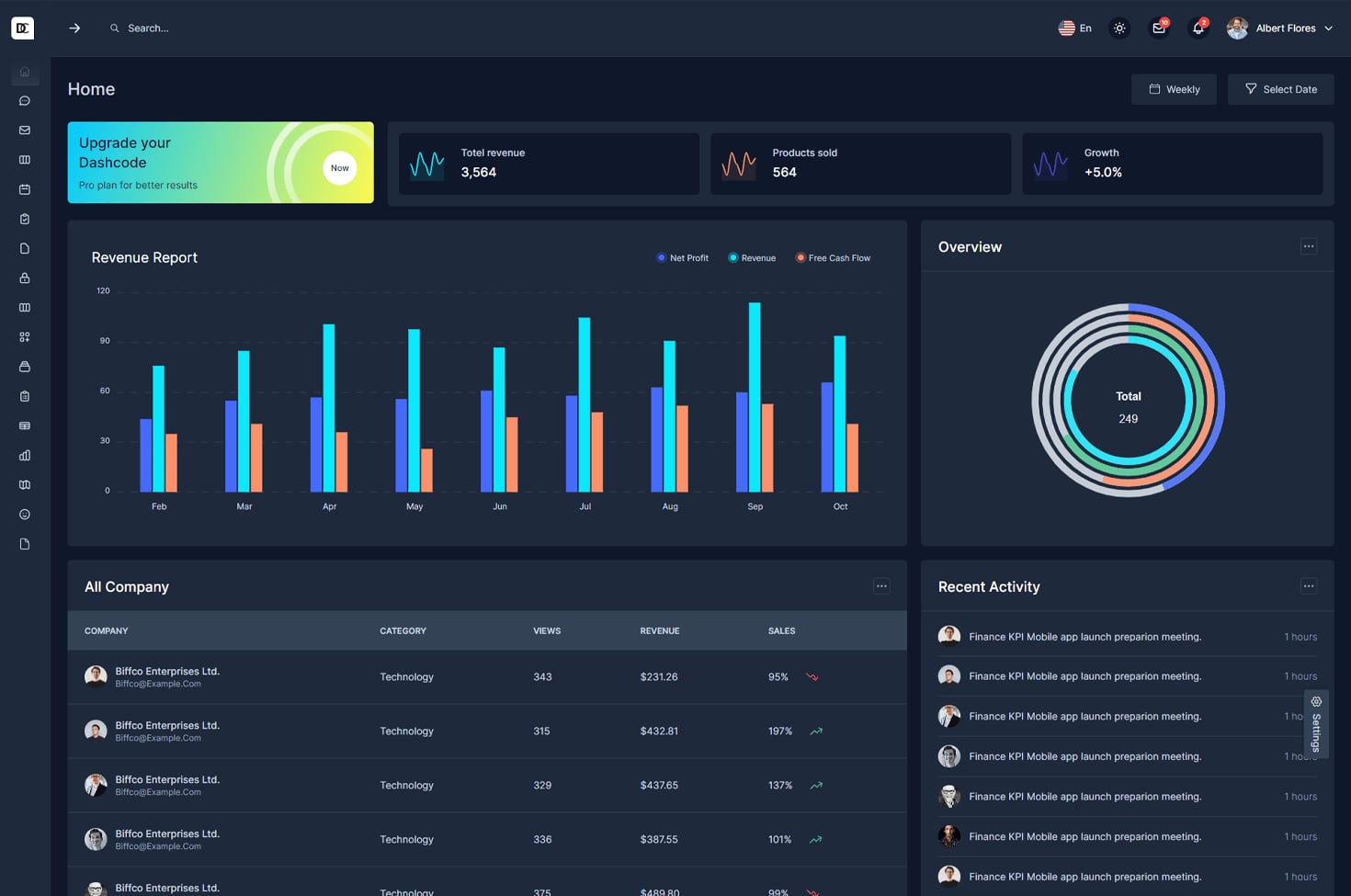
DashCode is a commercial admin dashboard template that supports React, Vue, Next.js, Laravel, HTML, Tailwind CSS, and Headless UI. The marketplace listing describes preview dashboards for analytics, banking, CRM, e-commerce, and project use cases. (themeforest.net)
Best for: teams that want a multi-framework dashboard product with many business dashboard categories.
Materialize
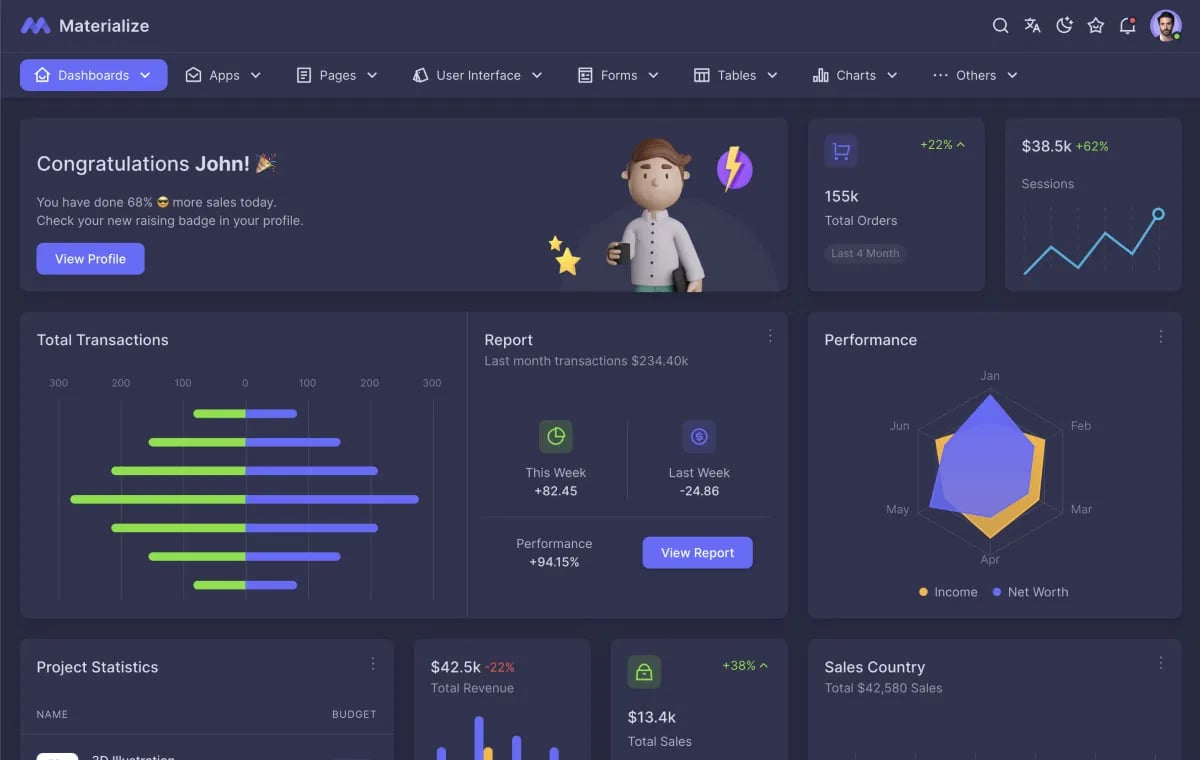
Materialize is a commercial Material Design admin template from Pixinvent. The ThemeForest listing includes Next.js, Vue, Nuxt, HTML, Laravel, Django, ASP.NET, Material Design, MUI, React, TypeScript, and related ecosystem tags. (themeforest.net)
Best for: teams that want a broad commercial admin template with Material Design patterns and multiple framework targets.
Horizon UI
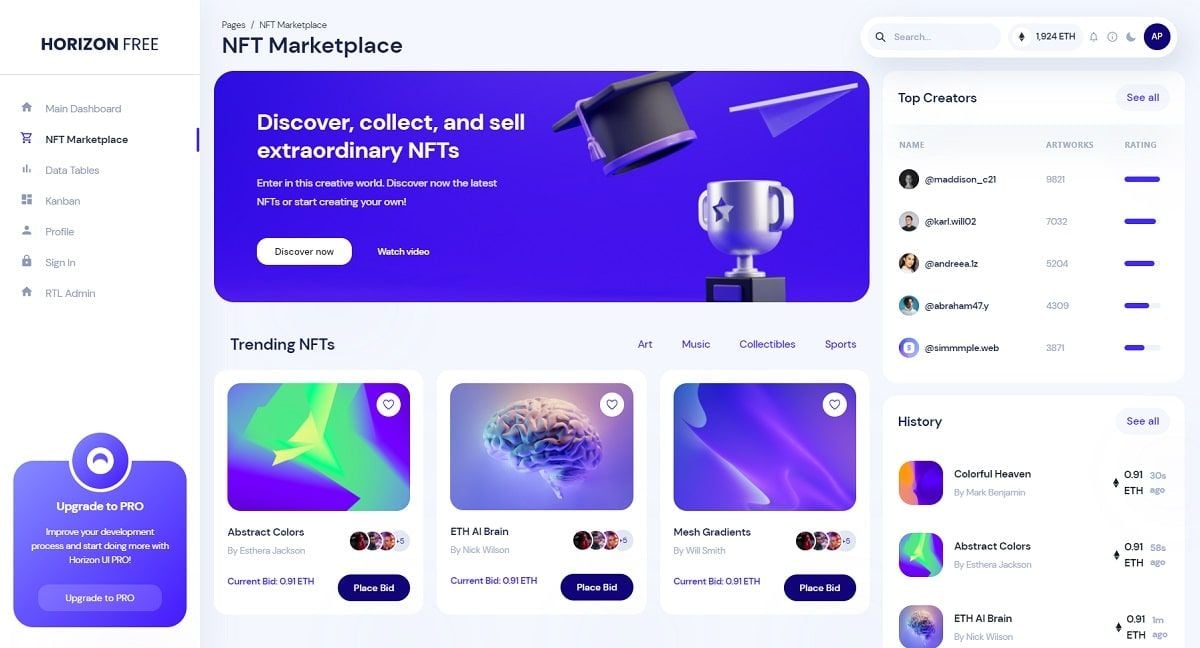
Horizon UI provides React admin templates for Chakra UI, Next.js, Tailwind CSS, and related stacks. Its official site positions Horizon UI around React admin templates with Chakra UI and TypeScript options. (horizon-ui.com)
Best for: teams that already use Chakra UI and want a dashboard with a familiar component model.
June 2026 note: these are worth considering when they match your existing stack. For a new Tailwind CSS v4 and Next.js 16 product, verify the exact package version and folder structure before starting.
Legacy/reference options
Windmill Dashboard
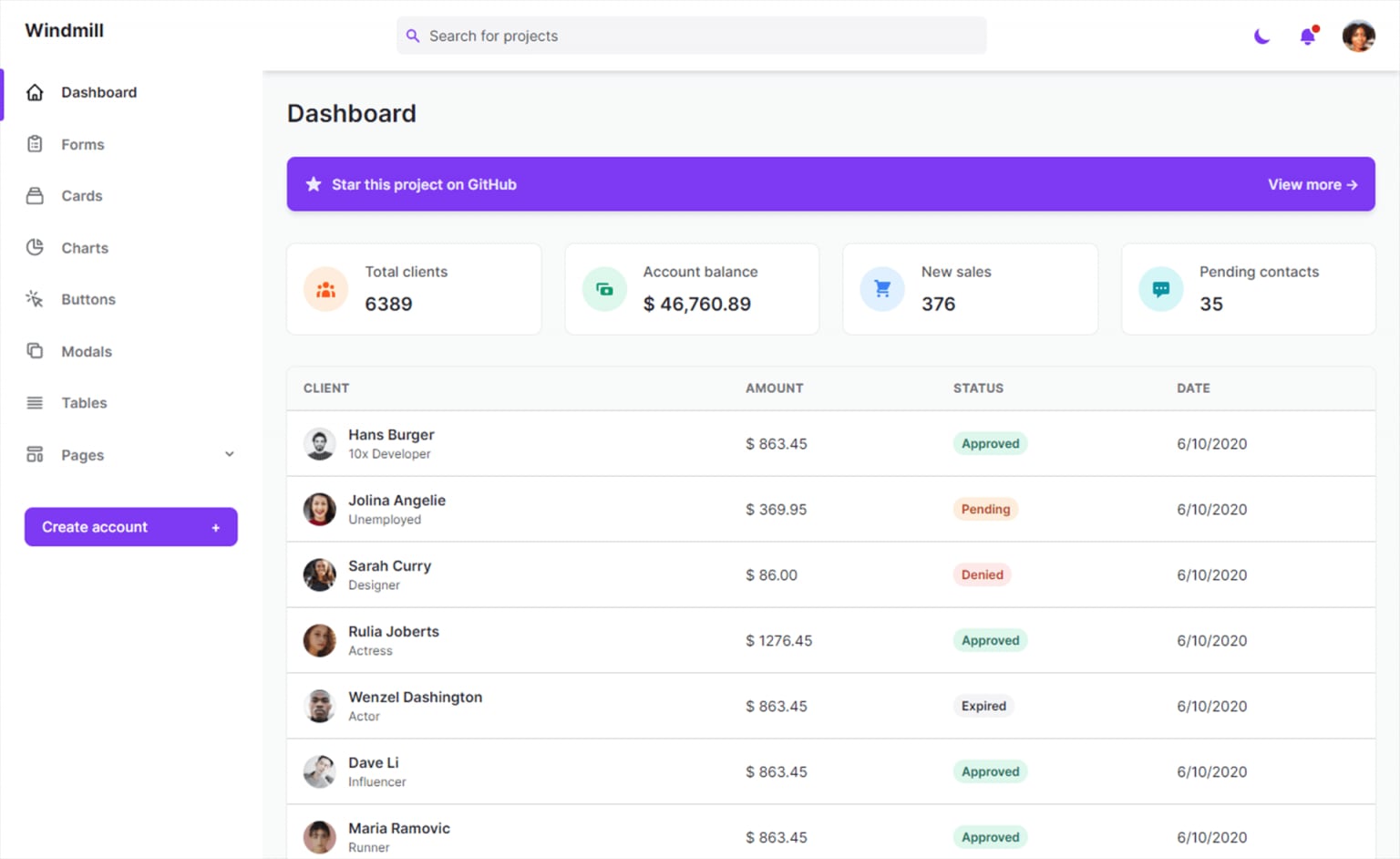
Windmill Dashboard for Next.js and TypeScript is better treated as a legacy/reference option in 2026. It can still be useful for UI inspiration or maintaining an existing Windmill-based dashboard, but check dependency versions, React compatibility, and package maintenance before using it in a new production app.
Older NextUI Dashboard starters
Older NextUI Dashboard starters can still be useful for reference, but NextUI is now HeroUI. The migration guide documents the package rename from @nextui-org/* to @heroui/*, and HeroUI v3 is now the current direction for new HeroUI-based React projects. (v2.heroui.com)
For new dashboards, start with HeroUI instead of copying old NextUI imports.
How to Choose the Right Dashboard Template
When selecting a dashboard template, do not start with screenshots. Start with product constraints.
1. Match the template to your product type
Choose based on what you are actually building:
- SaaS admin panel: roles, billing states, user management, analytics, activity logs.
- Fintech dashboard: transactions, balances, reports, audit-friendly states.
- CRM dashboard: contacts, pipelines, tasks, notes, search, filters.
- E-commerce admin: products, orders, inventory, fulfillment, refunds.
- AI dashboard: usage, credits/tokens, model settings, chat history, workflows.
- Internal tool: permissions, tables, forms, bulk actions, import/export.
If your product is finance-heavy, Aniq UI Financial Dashboard is more relevant than a generic admin starter. If your product needs roles, backend APIs, live notifications, multilingual support, and AI assistant workflows, Aniq UI Admin Dashboard Template 2 is the stronger fit. (aniq-ui.com)
2. Check framework freshness
For a new 2026 project, prioritize templates that are actively maintained and aligned with your target stack.
Look for:
- Next.js 16 support if you want the current Next.js baseline.
- React 19 compatibility.
- Tailwind CSS v4 support if your design system uses Tailwind.
- App Router support.
- TypeScript coverage.
- Clear install instructions.
- Recent commits or changelog updates.
- No stale imports from renamed UI libraries.
3. Evaluate the data layer
A dashboard is only useful once it connects to real data. Inspect how the template handles:
- Loading states
- Empty states
- Error states
- Pagination
- Filtering
- Sorting
- Mutations
- Auth-aware API calls
- Cache invalidation
- Form validation
TanStack Query is useful when your dashboard has many client-side data interactions. Server Components are useful when you can keep route-level data fetching on the server.
4. Inspect the UI states, not only the main dashboard screen
A polished dashboard needs more than charts and stat cards. Check whether the template includes:
- Empty table states
- Error banners
- Skeleton loaders
- Form validation messages
- Disabled button states
- Confirmation dialogs
- Responsive sidebar behavior
- Mobile navigation
- Keyboard focus states
- Dark mode contrast
- RTL behavior if you need Arabic or Hebrew support
5. Consider total cost
A free template is not always cheaper if you spend days upgrading dependencies, replacing auth, redesigning tables, and fixing mobile layouts.
A premium template makes sense when it gives you a reliable head start on the product you are shipping. A free template makes sense when your team wants maximum control and is comfortable doing the integration work.
6. Getting started
Most dashboard templates follow a similar setup process:
PlainBashC++C#CSSDiffHTML/XMLJavaJavaScriptMarkdownPHPPythonRubySQL
<span class=<span class="ql-token hljs-true">"ql-token hljs-comment"># Clone or download the template</span></span>
git <span class=<span class="ql-token hljs-true">"ql-token hljs-built_in">clone</span> [repository-url]</span>

<span class=<span class="ql-token hljs-true">"ql-token hljs-comment"># Install dependencies</span></span>
npm install

<span class=<span class="ql-token hljs-true">"ql-token hljs-comment"># Start the development server</span></span>
npm run dev
If the template supports multiple package managers, use the one documented by the template author. Avoid mixing lockfiles unless your team intentionally standardizes the project after download.
7. Performance optimization tips
Use these practical checks before launch:
- Use
next/imagewhere appropriate, especially for avatars, thumbnails, and media previews. The Next.js Image component extends<img>with automatic image optimization. (nextjs.org) - Keep interactive widgets isolated so chart libraries and heavy tables do not pull unrelated UI into the client bundle.
- Load charts only where needed instead of importing every chart type into the main dashboard shell.
- Remove unused demo code such as mock routes, sample pages, unused icon packs, and placeholder data.
- Test real datasets, not only the demo data included in the template.
8. Customization best practices
- Create design tokens first: colors, spacing, radius, shadows, typography, and chart colors.
- Customize high-traffic screens first: dashboard overview, tables, forms, settings, and auth flows.
- Keep components composable: cards, tables, filters, modals, and forms should be reusable.
- Document layout rules: sidebar behavior, page headers, breadcrumbs, actions, and responsive breakpoints.
- Use TypeScript consistently: especially for table rows, form payloads, API responses, and chart data.
- Remove demo routes before launch: unused pages confuse users and increase maintenance work.
- Test accessibility basics: keyboard navigation, focus states, labels, contrast, and form errors.
Common pitfalls
Choosing a template only because the homepage looks good
The homepage screenshot is usually the most polished part of the template. Open the tables, forms, settings pages, auth screens, mobile sidebar, and empty states before deciding.
Ignoring dependency age
A template can look modern while depending on old framework versions. For a 2026 project, verify the actual package versions before building on top of it.
Mixing too many UI systems
Avoid combining MUI, Chakra UI, HeroUI, Radix UI, shadcn/ui-style components, and custom Tailwind components without a design-system plan. The result is usually inconsistent spacing, duplicated tokens, and confusing component APIs.
Treating dashboards like static landing pages
Dashboards need loading states, permissions, mutations, filters, and error handling. A static UI kit is not enough for a production admin panel.
Forgetting role-based UX
If your dashboard has admins, managers, support users, and read-only users, plan permissions early. Hiding links in the sidebar is not the same as enforcing access control in the backend.
Overusing Client Components
Use Client Components where the UI needs browser interactivity. Do not turn the entire dashboard into a client-rendered app if only charts, filters, forms, and drag-and-drop widgets need client-side behavior.
Copying old NextUI examples without migration
NextUI is now HeroUI. The official migration guide documents package renames from @nextui-org/* to @heroui/*, and HeroUI v3 is built around Tailwind CSS v4 and React Aria Components. (v2.heroui.com)
FAQ
What is the best Next.js admin dashboard template in 2026?
For a full-stack SaaS-style dashboard, Aniq UI Admin Dashboard Template 2 is the strongest option in this list because it combines a Next.js 16 frontend with an optional NestJS backend, JWT authentication, RBAC, WebSocket updates, multilingual support, Arabic RTL support, and an MCP-compatible AI assistant. (aniq-ui.com)
For a free Tailwind dashboard, TailAdmin is a good starting point because its current README lists Next.js 16.x, React 19, TypeScript, and Tailwind CSS v4. (github.com)
What is the best free Next.js dashboard template?
TailAdmin and NextAdmin are the best free options in this list for most developers. TailAdmin is a strong Tailwind-first starter, while NextAdmin is useful when you want a broader component set and admin-panel structure. (github.com)
What is the best premium Next.js dashboard template?
If you need a full-stack admin panel with backend features, Aniq UI Admin Dashboard Template 2 is the best premium option here. If you are building a fintech, banking, or finance product, Aniq UI Financial Dashboard is more focused. (aniq-ui.com)
Should I use a free or premium dashboard template?
Use a free template if your team wants full control, has time for integration, and can handle dependency upgrades. Use a premium template if the design, architecture, and included features closely match the product you need to ship.
Is Next.js good for internal admin dashboards?
Yes. Next.js works well for internal dashboards when you use the App Router thoughtfully: Server Components for server-owned data, Client Components for interactive UI, Route Handlers for custom endpoints, and a clear auth/permission model. (nextjs.org)
Is Tailwind CSS better than MUI for dashboards?
Neither is universally better. Tailwind CSS is a good fit when your team wants a custom design system and utility-first styling. MUI is a good fit when your team wants a Material-style component system with many predefined UI patterns.
What should I check before buying a dashboard template?
Check framework versions, license terms, included pages, auth approach, backend support, TypeScript quality, responsive behavior, accessibility, documentation, update history, and whether the demo screens match your real product requirements.
Is NextUI still recommended for new dashboards?
For new projects, use the current HeroUI ecosystem instead of old NextUI imports. NextUI was rebranded as HeroUI, and the official migration guide documents the package rename and migration path. (v2.heroui.com)
Do dashboards need SEO?
Authenticated dashboard screens usually do not need to rank in search. However, the overall application still benefits from good metadata, performance, accessibility, semantic structure, and crawlable public pages such as landing pages, docs, changelogs, and pricing pages.
Conclusion
The Next.js dashboard ecosystem is stronger in June 2026 than it was in the original 2025 version of this post. The best choice depends on what you are shipping.
Choose Aniq UI Admin Dashboard Template 2 if you want a premium full-stack SaaS/admin foundation with a Next.js 16 frontend, optional NestJS backend, RBAC, real-time updates, multilingual support, Arabic RTL support, and AI assistant features. Choose Aniq UI Financial Dashboard if your product is fintech, banking, investment, or finance-focused. (aniq-ui.com)
Choose TailAdmin or NextAdmin if you want a free Next.js dashboard starter. Choose Modernize or Materio if your team prefers MUI and Material Design patterns. Choose Vercel Admin Dashboard if you want a deployable Vercel-oriented reference starter. Choose HeroUI Dashboard / HeroUI Pro if your team wants to standardize on HeroUI components.
The right dashboard template should reduce repetitive setup work without locking you into the wrong architecture. Start with your product requirements, verify dependency versions, inspect real UI states, and pick the starter that gets you closest to production with the least rework.
Browse the full collection of Next.js admin dashboard templates on Aniq UI to compare live demos, pricing, and features side by side.
Found this article helpful?
You might also like

Best Dark Mode Dashboard Designs for 2026: 22 Real Screenshots
22 real dark mode dashboard screenshots plus live clips: e-commerce admin, fintech and SaaS, in dark and light, with the surface scale, contrast and chart palette behind them.
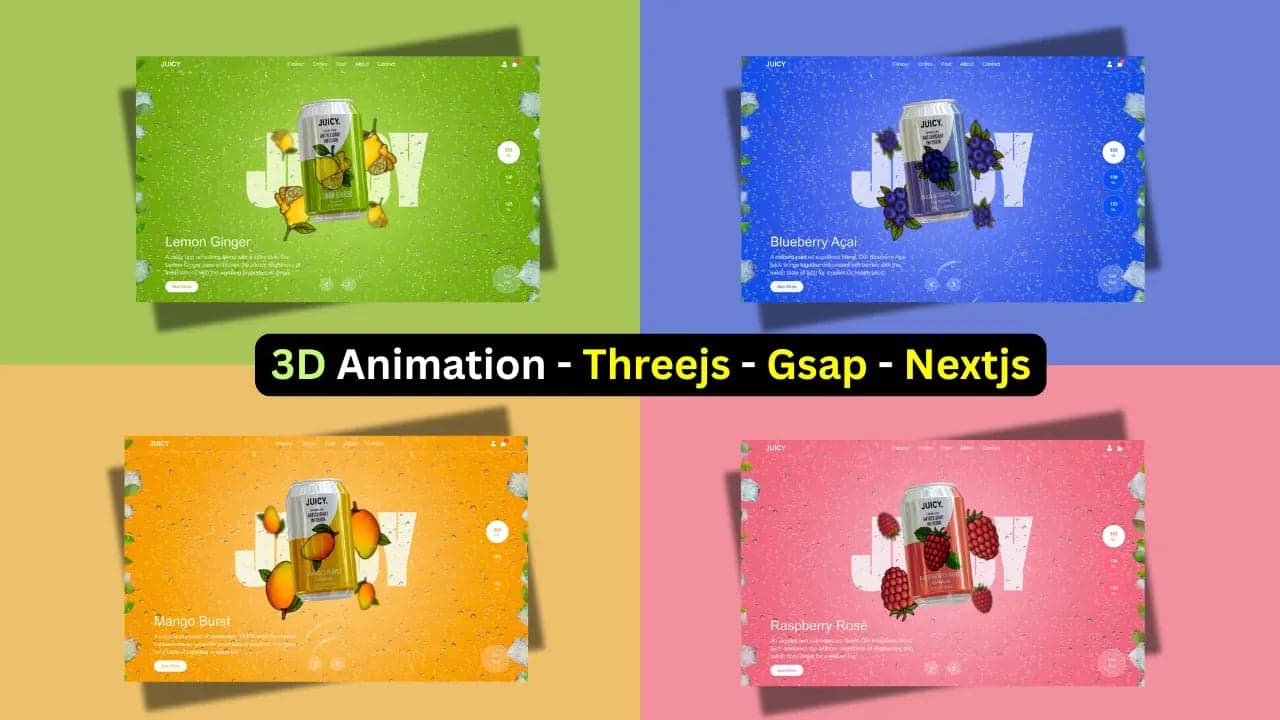
Free 3D Landing Page Template for Juice, Beverage, and Product Marketing Websites (Next.js + Three.js + GSAP)
Download a free 3D animated landing page template, built with Tailwind CSS, Three.js, and Next.js App Router. Perfect for product websites or creative showcases.
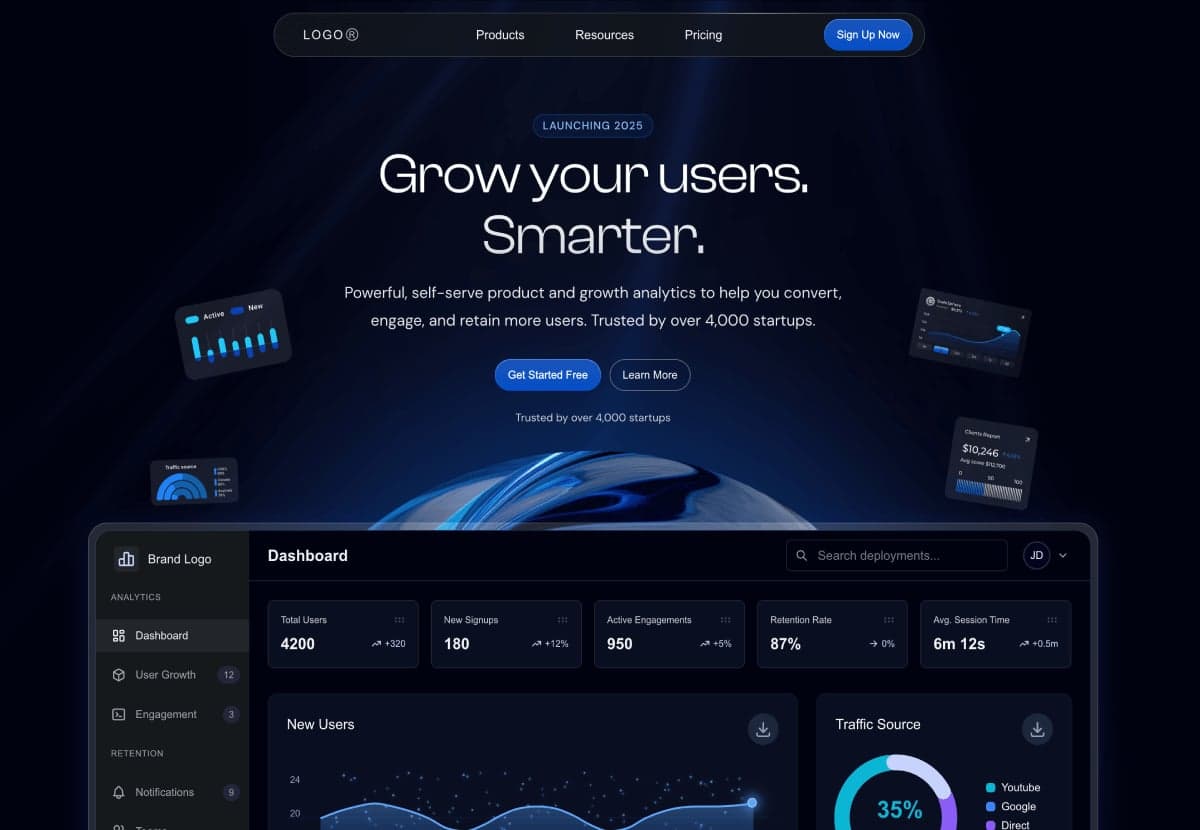
Free Landing Page Templates
Explore three free, production-ready landing page templates, perfect for agencies, corporate sites and SaaS startups. Built with Next.js 15.2.4 and Tailwind CSS for lightning-fast performance and modern design.
